
Ear position can offer early clues about whether a cat or dog is relaxed, alert, uncertain, or asking for space.
The half-back ear that says: I'm listening, not joining
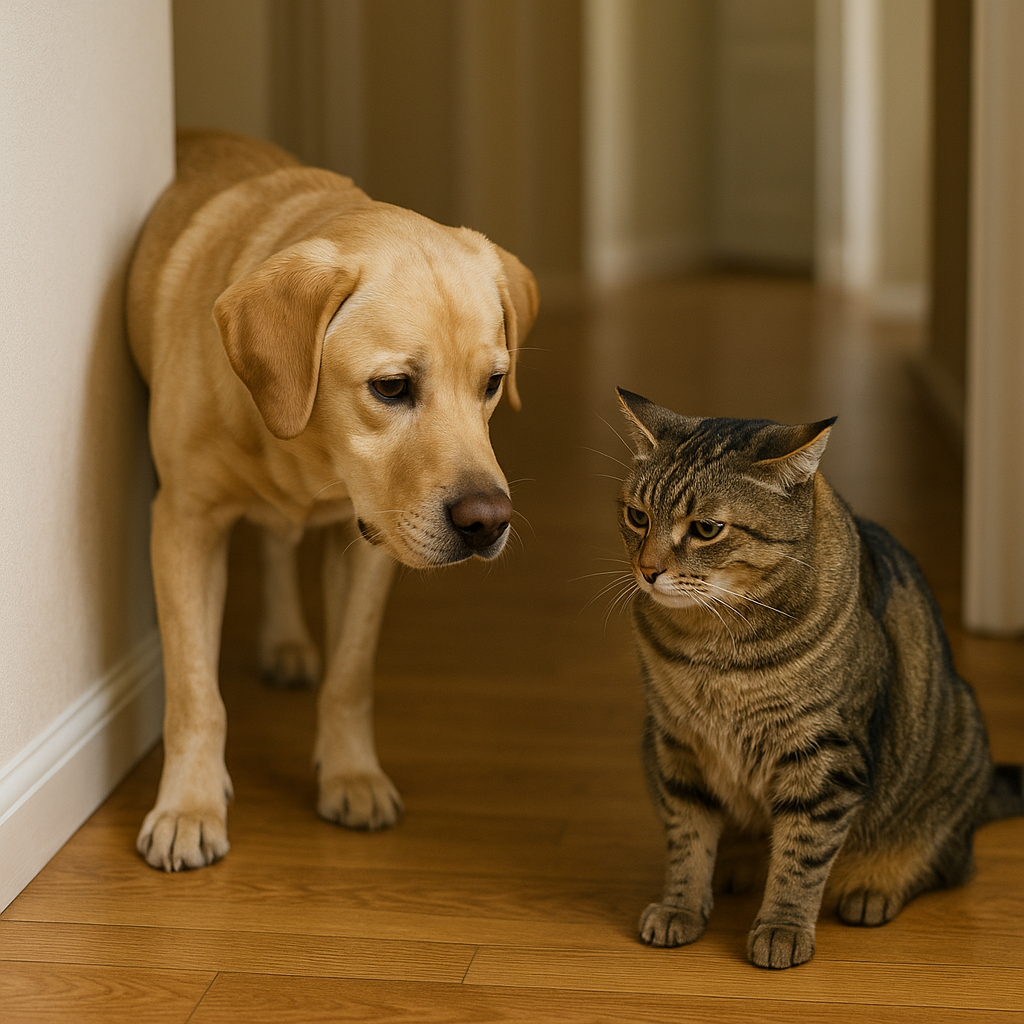
The quietest moment in my house is the one that looks the most polite: the dog slows down in the hallway, the cat stays put, nobody growls, nobody hisses. If you only watch faces, you'll miss the entire conversation. The tell is the in-between ear position where the cat's ears aren't pinned flat, but aren't forward either. They slide halfway back, like the cat is keeping one ear on the dog and the other on whatever escape route is closest (mine is usually the back of the sofa or the top of a bookcase). It can signal uncertainty or heightened attention, especially when the ears stay partly rotated back.
Here's how it plays out. The dog does that soft, hopeful step-in, head low, tail doing its own little metronome. The cat keeps its body still and lets the dog close the distance, but those ears stay half-back. I take that combination as a cue that the cat may be unsure and could use a little more space. If the dog also relaxes, you may see its ears and gaze soften. They relax outward instead of pricking hard forward, and the dog's eyes stop locking on the cat like it's a new app notification. The whole thing dissolves into nothing, which is the best outcome.
If I'm trying to keep the peace, I don't intervene with big gestures. I just make the dog curve away so the approach isn't straight-on, and I keep my own voice boring. The half-back ears are one of the signals I watch. If they drift forward and the rest of the cat's body stays loose, I take that as a sign the cat may be feeling more comfortable. If they stay half-back and the tail starts flicking in short, sharp beats, I take that combination as a sign the cat may be getting uncomfortable, so I give it more space.
Airplane Ears and the Small Shifts Worth Watching
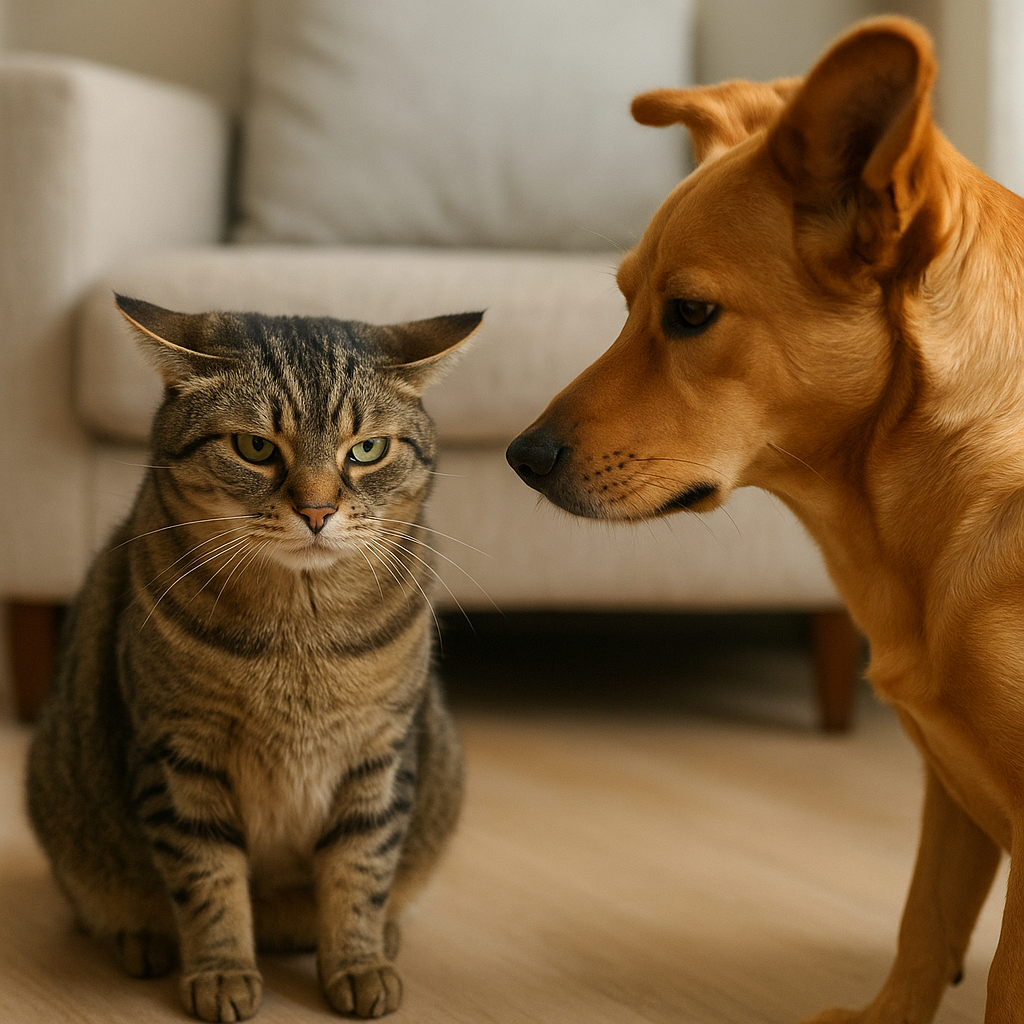
My least favorite myth is that a cat who isn't hissing is fine. Some cats are quiet right up until they are not. One ear position I watch for is what I call airplane ears: not flattened, but pushed out to the sides so the head looks wider. It can be a sign of tension, uncertainty, or defensiveness, and it can happen while the cat is still sitting neatly like a porcelain figurine. If you wait for a dramatic signal, you're late.
I also watch for repeated ear swiveling when the dog moves or a new sound enters the room. That can simply mean the cat is tracking what is happening around it, so I read it alongside posture, tail movement, pupils, and whether the cat is trying to create distance. In my house, it shows up when the dog pauses near the food bowl area or when someone rustles a treat bag and the dog gets bouncy. I read that combination as the cat wanting to stay put without having the dog crowd its space.
Dogs have their own ear tells here. A dog with forward ears and a tense, stiff body may be highly aroused or uncomfortable, especially if the dog is also staring hard or leaning forward. That combination tells me the interaction may be getting more tense. When I see it, I manage the environment, not the animals' feelings. I move the resource (bowls get picked up, treats go into a cabinet), and I ask the dog for a simple behavior it already knows, so the dog's body softens. If the dog's ears settle back to neutral and the cat's airplane ears relax into a more forward angle, the room feels normal again. If the cat keeps its ears turned sideways or back and the rest of its body remains tense, I give it more space and an easy exit.
One ear forward, one ear back: the split-screen scan
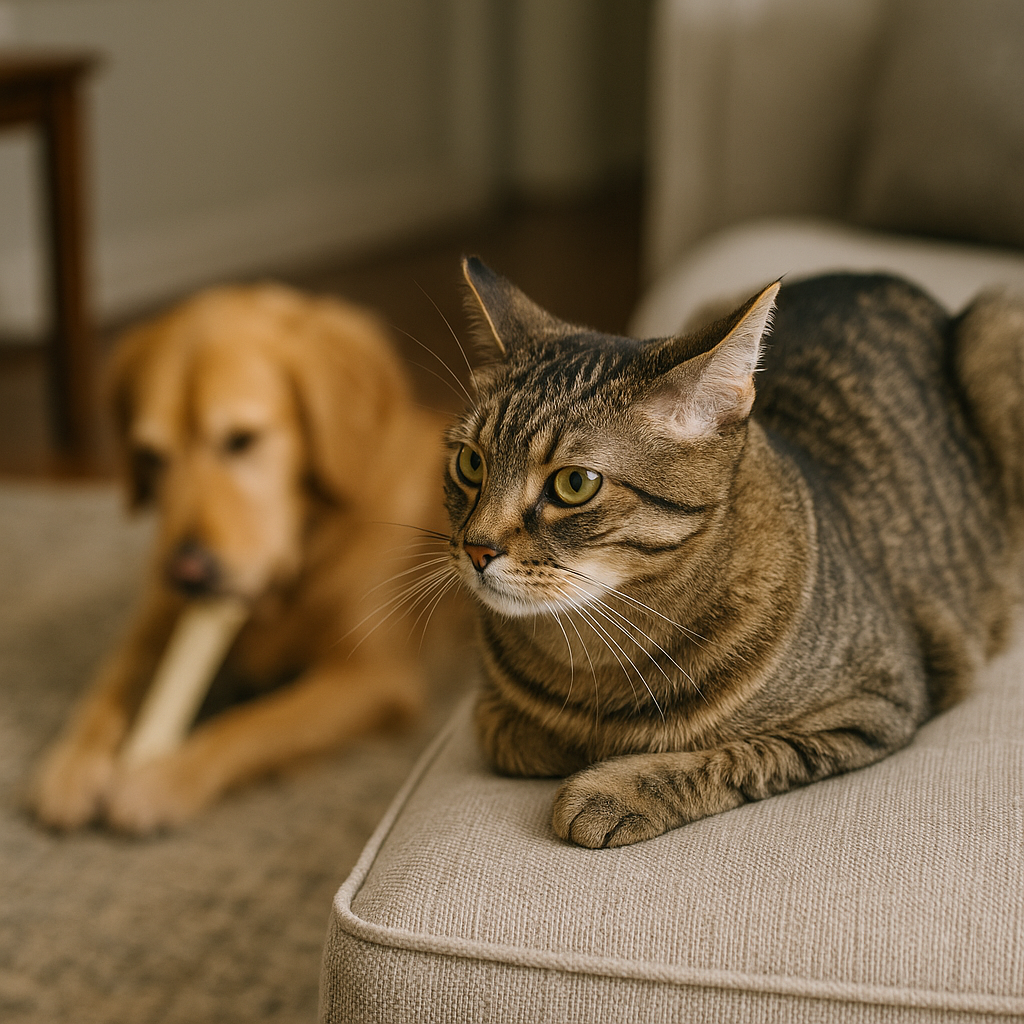
There are days when the animals are technically in the same room but living in different realities. The dog is chewing a Benebone on the rug, happy as can be, and the cat is perched on the arm of the couch, doing that relaxed-looking loaf. Then a sound happens. The mail slot clacks, the neighbor's dog barks, or a delivery truck sighs outside. The cat doesn't move its body much, but the ears split: one ear points forward toward the room, and the other swivels back toward the noise. It looks like the cat is running two tabs at once.
This split-ear scan shows how quickly attention can shift in a shared room. The dog may pause mid-chew and lift its head, reacting to the cat's movement, the outside noise, or both. The dog might stand up, stretch, and wander closer to the couch. That's where the ear split matters: if the cat keeps one ear forward toward the dog while the other tracks outside noise, the cat is aware of the approach yet still chooses to stay put.
What I do in that moment is boring on purpose. I don't call the cat, and I don't hype the dog. I toss a single piece of kibble or a small treat away from the couch so the dog turns its head and breaks the line of approach. Then I watch the cat's ears, because they're faster than the tail. When both ears settle into a more neutral position, and the rest of the cat's body stays loose, I take that as a sign that the tension may be easing. If the ears keep swiveling independently, the cat may still be monitoring several things at once, and that's my cue to keep the dog's path wide and give the cat the higher perch. A window ledge, a cat tree, or even the top step of the stairs helps. The cat isn't necessarily being aloof. Those moving ears are helping it keep track of what is happening around the room.