4 Animals That Have the Most Brutal Start to Life in the Wild
Life in the wild rarely offers a soft beginning. For many animals, birth does not come with safety, patience, or time to adjust. It starts with exposure. Movement is demanded almost immediately, and survival is often decided within moments rather than days.
The animals below are not unusual outliers. They show how harsh early life can be when evolution favors speed, numbers, or efficiency instead of protection. From the first breath, they face conditions where hesitation carries real cost and where many never make it past the earliest stage of life.
Sea Turtles
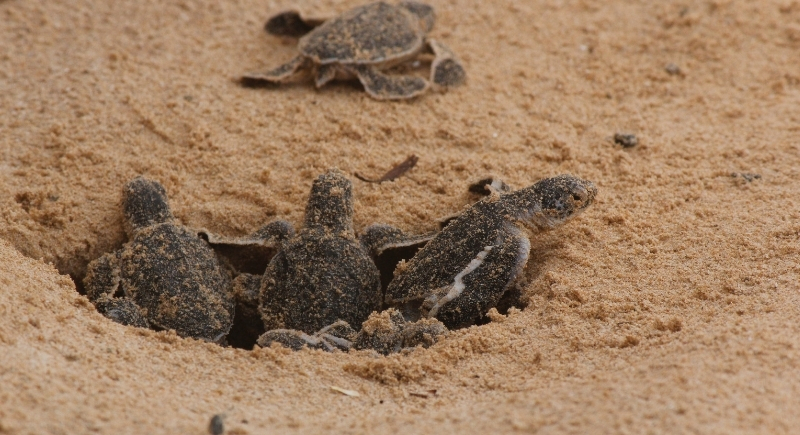
Image via Getty Images/Shakeel Sha
A sea turtle’s life begins underground. Dozens of hatchlings break free from their shells beneath the sand and surface together, usually at night. Once they emerge, there is no pause. The ocean is not nearby in any meaningful sense. The distance between nest and water can stretch well over 100 feet of open beach.
During that crawl, hatchlings are exposed to birds, crabs, and other coastal predators. There is no protection and no guidance beyond instinct. Artificial lighting, uneven sand, and obstacles can further delay or misdirect movement. Survival rates are extremely low. Rough estimates often place the odds at around 1 in 1,000 reaching adulthood.
Heavy losses occur both on the beach and in the early period after entering the ocean, where young turtles face intense predation before growing large enough to reduce their vulnerability.
Praying Mantises
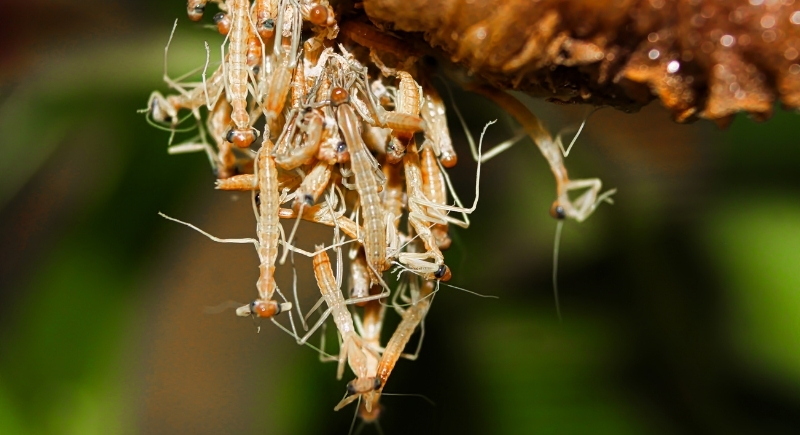
Image via Canva/akchamczuk
Praying mantises hatch from egg cases called oothecae. When the eggs open, large numbers of nymphs emerge at once. They resemble tiny versions of the adult and are capable of movement shortly after hatching, though their bodies are soft and they remain highly vulnerable.
The environment they enter does not change to accommodate them. Food is not provided, and shelter is limited. Nymphs disperse quickly and begin hunting small insects such as flies, aphids, and other invertebrates. Cannibalism is common, particularly when individuals encounter one another in close quarters or when prey is scarce.
As a result, the number of survivors declines rapidly over time. Losses are driven by a combination of predation, cannibalism, and environmental exposure. This outcome is not a breakdown of behavior, but a natural consequence of producing many offspring in environments where only a fraction are expected to survive.
Marine Iguanas

Image via iStockphoto/norbiy
Marine iguanas are born on land in the Galápagos Islands, where their nesting areas overlap with dense snake populations. Hatchlings emerge from underground nests into open terrain where predators are already present.
Within moments, they must run. There is no period of rest or parental protection. Racer snakes actively pursue hatchlings across the terrain, often converging on the same group. The young iguanas must reach rocky crevices or vegetation for cover, sometimes over distances exceeding 100 feet.
Survival during this initial escape is low, and injuries are common even among those that reach shelter. For marine iguanas, the first minutes after emergence play a decisive role in determining which individuals persist.
Wildebeests
Wildebeest calves are born directly into moving herds during the calving season in East Africa. There is no nesting area and no separation from herd activity. Within minutes of birth, calves must stand. Shortly after, they must move.
The herd does not pause for long. Predators are already present in calving areas, drawn by the density of births. Calves that fall behind are exposed immediately. Trampling, separation, and predation all occur within the first hours.
This rapid start is essential to the species’ survival at scale. Hundreds of thousands of calves are born within a short window, overwhelming predators through sheer numbers. Individually, however, the conditions are unforgiving.