Animals With Bizarre Senses That Feel Like Pure Science Fiction
Humans rely on sight, sound, taste, touch, and smell to explain the environment around us. But that may not seem impressive to you when you realize that there are various species out there that detect electricity, infrared radiation, and even planetary magnetic fields as naturally as we notice color. This is all thanks to evolution, which has shaped sensory systems that gather data we never register.
Bumblebees Detect Electric Fields

Credit: Wikimedia Commons
As a bee flies, friction with air particles gives its body a small positive charge. Flowers naturally carry a negative charge simply by remaining grounded in soil. Tiny hairs on the bee’s legs respond to that electrical contrast. The insect senses the field before landing. After a visit, the flower’s charge moves temporarily. Other bees can sense the change and move on.
African Bush Elephants Have Powerful Olfactory Genes

Credit: Wikimedia Commons
The trunk of an African bush elephant contains more than 2,000 olfactory receptor genes, which gives this species the strongest recorded sense of smell among land mammals. Genetic comparisons show that dogs possess roughly half that number. This advantage allows the identification of distant water sources across dry terrain.
Pit Vipers Can Perceive Infrared Radiation
Credit: Wikimedia Commons
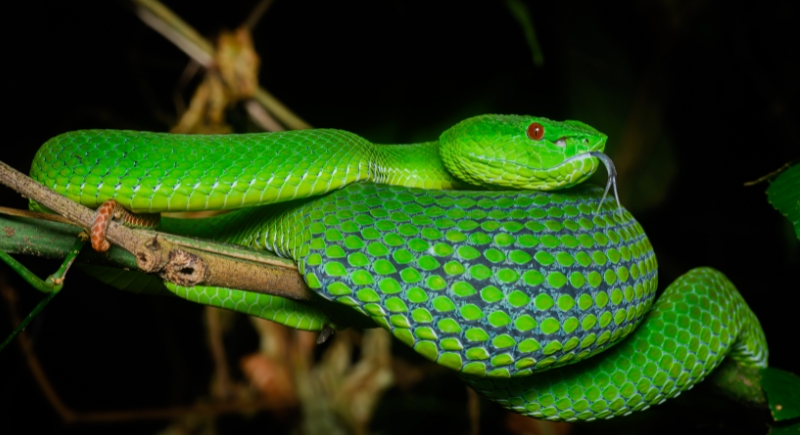
If you take a close look at the pit viper, you will see that specialized cavities, known as pit organs, sit between its eyes and nostrils. These pick up infrared radiation emitted by the body as heat. Nerve endings inside the pits then translate temperature differences into spatial information. This allows the snake to form a thermal map of nearby creatures without relying on visible light.
Mantis Shrimp Have Advanced Visual Systems
Credit: Wikimedia Commons
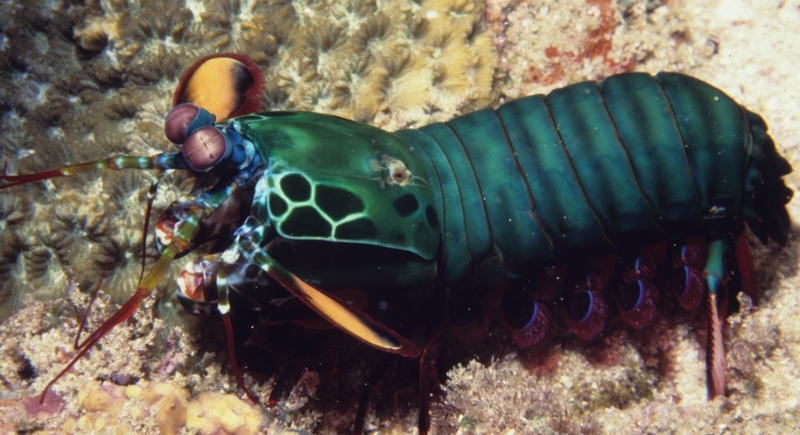
Vision in this marine crustacean operates on a scale that challenges human comparison. The eyes of a mantis shrimp contain up to 16 photoreceptor types, far exceeding the 3 used in human color detection. The animal also interprets circularly polarized light, a rare capability in nature.
Hammerhead Sharks Sense Electrical Fields

Credit: Wikimedia Commons
Along the underside of the head of a hammerhead shark, there are thousands of gel-filled sensory pores called ampullae of Lorenzini. These pores locate weak energy fields generated by muscle contractions in other organisms. Even a fish buried under sand produces measurable electric signals. This electroreception allows the detection of hidden prey that remains invisible to normal sight.
Great Grey Owls Hunt Through Sound

Credit: Wikimedia Commons
It is not unusual for the hunting strategies of birds of prey to rely heavily on sound rather than on sight. In this northern raptor, a large facial disc gathers faint noises and funnels them toward asymmetrical ears set at different heights. Field studies show that great grey owls can even register rodents moving beneath a couple of feet of snow.
Platypuses That Hunt with Electroreception
Credit: Wikimedia Commons
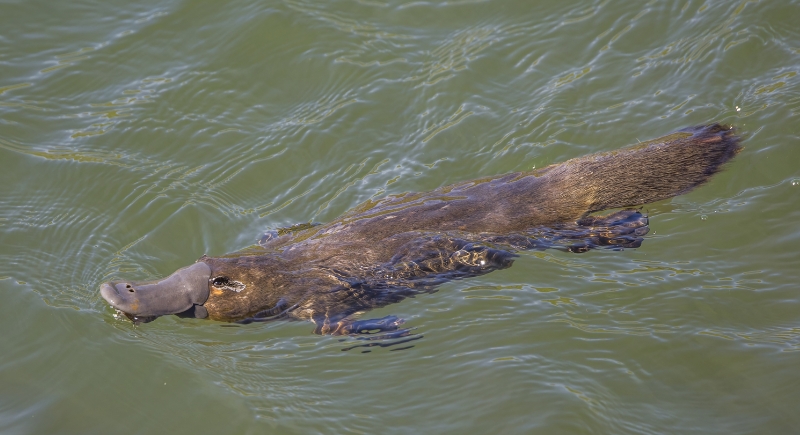
Underwater foraging in platypuses depends almost entirely on electrical perception. Its bill contains thousands of electroreceptors that can detect tiny electrical impulses generated by muscle movement. During dives, the animal closes its eyes, ears, and nostrils and depends solely on such cues in murky streams.
Vampire Bats Identify Heat Differences
Credit: Wikimedia Commons
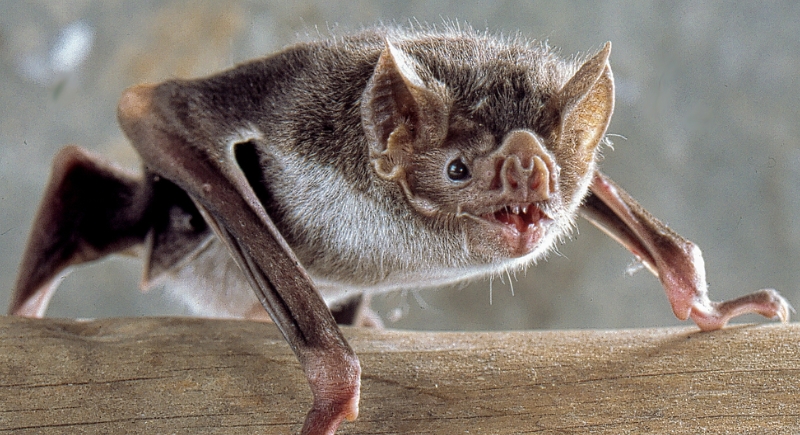
Heat recognition guides feeding behavior in vampire bats. Specialized receptors near the nose connect to modified TRPV1 proteins that respond to temperature changes. On that note, warm blood flowing near the skin surface creates a thermal pattern. The bat uses that information to choose precise feeding spots during nighttime activity.
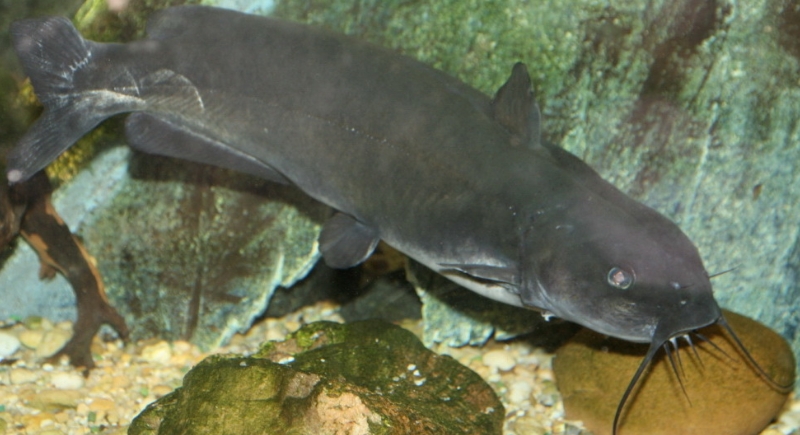
Catfish Taste Their Environment
Credit: Wikimedia Commons
You may assume taste happens only inside a mouth, yet this freshwater fish spreads chemical location across its entire body. Taste receptors cover the skin and whisker-like barbels, and total numbers exceed 100,000 in some organisms. In dark waters, prey release chemical traces into the water. The fish senses those signals and moves directly toward the source.
Harbor Seals Track Hydrodynamic Trails

Credit: Wikimedia Commons
Long facial whiskers of the harbor seals serve as sensitive motion detectors in cold coastal waters. Each whisker contains thousands of nerve endings that respond to subtle flow disturbances. When a fish swims away, it leaves behind a distinct wake pattern. Controlled experiments show that seals can follow these trails after visual contact disappears.