Croatia Is One of the Few Countries That Employs Dog Lifeguards
Croatia has one of the busiest coastlines in Europe during peak summer months, with rescue teams preparing in advance for increased swimmer volume, stronger currents, and tighter beach spaces. Safety planning along the Adriatic relies on a layered system that combines trained personnel, strict patrol schedules, and specialized rescue equipment.
Within that system, Croatia has taken a less common step that sets it apart from most beach destinations. On certain stretches of the coast, trained rescue dogs work directly alongside human lifeguards and step in when conditions become difficult or time is of the essence. The practice comes from Italy, where canine water rescue teams have been trusted for decades, and it adds speed and confidence when lives are at stake.
Why Dogs Are Part of the Rescue Plan

Image via Canva/Aflo Images
The dogs used in these programs are chosen for specific physical traits and temperament, with Labradors, Golden Retrievers, and Newfoundlands dominating the roster. Their strength allows them to tow adults through open water, and their calm behavior helps prevent panic during rescues. Their coats resist water absorption, and Newfoundlands have webbed paws that improve propulsion.
Training lasts close to three years. During that time, dogs learn to recognize distress, control their swimming in waves, and respond in a coordinated manner with human lifeguards. Some drills involve launches from boats. Advanced teams even train for helicopter deployment during high-risk emergencies. Once certified, these dogs are never allowed to work alone. A human lifeguard directs each rescue, managing communication and medical response while the dog focuses on extraction.
How a Rescue Actually Works

Image via Getty Images/Sephirot17
When swimmers run into trouble, speed matters more than force. A trained dog wears a flotation vest designed for towing. Lifeguards instruct up to two conscious swimmers to hold onto the vest while the dog pulls them toward shore. The lifeguard handles the third person or manages breathing support while guiding the group. In some cases, dogs tow small floating platforms that give victims extra stability. This setup enables a single rescue unit to secure multiple people in a single operation, thereby reducing the time spent in dangerous water.
In Croatia, a portion of the roughly 300 trained dog lifeguards operating across Italy and Croatia are deployed at select coastal locations during the summer season. Croatian rescue teams report that these dogs help save hundreds of swimmers each year by accelerating extraction times in challenging water conditions. Lifeguard authorities also note a practical advantage. Canine assistance reduces the frequency of repeated deep-water entries by human rescuers, thereby lowering physical strain and injury risk during peak crowd periods.
Clearing Up the Internet Confusion
Online posts often exaggerate this system. Viral photos depict sandy beaches that do not accurately represent much of Croatia’s rocky coastline, and some images circulate without accurate location details. Locals regularly call this out, and they are right to do so. Dog lifeguards do exist in Croatia, yet they are not stationed on every beach, nor do they patrol nonstop. They operate at specific locations, during particular periods, under official supervision.
An Advantage for Beachgoers
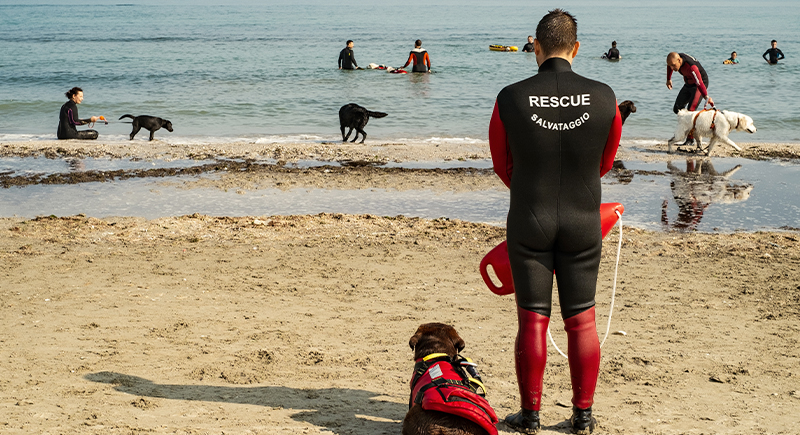
Image via iStockphoto/GiorgioMorara
Tourists rarely notice these dogs unless a rescue unfolds nearby, but that subtle presence is intentional, because the system focuses on readiness rather than spectacle. Dogs wait, train, and deploy only when needed, adding muscle and stability to rescue teams already stretched thin during peak season. Croatia continues to refine this approach, blending proven methods with careful oversight.