Doctors Say Owning This Pet Will Make You Live Longer
In 2009, researchers at the University of Minnesota Stroke Institute reviewed national health data published in the Journal of Vascular and Interventional Neurology. They found that people who had owned cats were about 30 percent less likely to die from a heart attack or stroke than those who never had one. What stood out was the focus on fatal cardiovascular events rather than general well-being.
Heart health continues to be a focus of pet research. The Centers for Disease Control and Prevention reports links between pet ownership and lower blood pressure, cholesterol, and triglyceride levels. Those markers shape long-term heart risk. A cat will not push you to exercise, but living with one may support your heart in ways that add up over time.
Stress Hormones Change

Image via Getty Images/Harbucks
Ten minutes with a pet can significantly lower cortisol levels, according to a 2019 study published in Frontiers in Psychology. Cortisol drives the body’s stress response, and chronic elevation increases risk for hypertension, immune suppression, and heart disease. Lower stress hormones often mean lower blood pressure.
In controlled experiments measuring heart rate and blood pressure under stressful tasks, pet owners showed calmer physiological responses than non-owners. The calming effect translated into faster recovery after stress exposure. Cats also trigger measurable brain activity.
Research has shown increased activation in the prefrontal cortex and inferior frontal gyrus during interaction with cats. Those regions influence decision-making, emotional regulation, and social processing.
The Brain Ages Differently
In July 2025, a study published in Scientific Reports analyzed 18 years of data from the Survey of Health and Retirement in Europe, tracking adults aged 50 and older. The lead researcher, Adriana Rostekova of the University of Geneva, found species-specific differences.
Dog owners retained stronger immediate and delayed memory. Cat owners, however, showed a slower decline in verbal fluency. Verbal fluency predicts cognitive resilience. It reflects how efficiently the brain retrieves words and organizes thoughts under time pressure. Slower decline suggests preserved executive function.
The Purr Factor
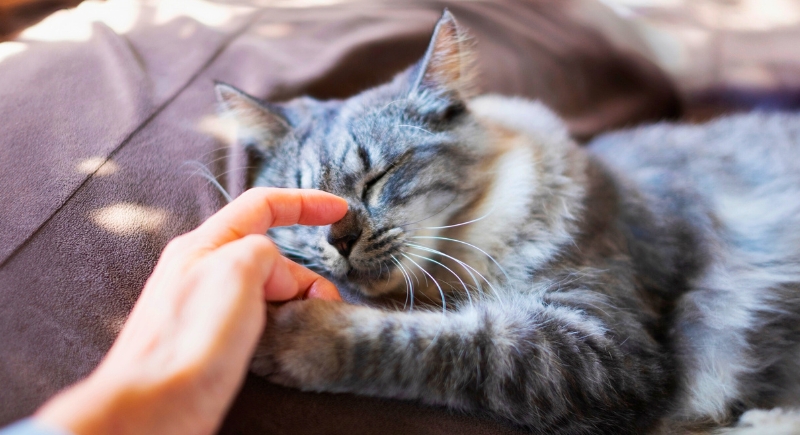
Image via Canva/Aflo Images
A cat’s purr falls between 25 and 150 Hertz. Some experts note that frequencies between 25 and 50 Hertz may stimulate muscle activity and support bone healing. Dr. Leslie Lyons, director of the Feline Genetics and Comparative Medicine Laboratory at the University of Missouri College of Veterinary Medicine, has explained that cats often purr at these lower frequencies.
The vibration alone does not guarantee bone repair in humans, yet the biological overlap is intriguing. At minimum, steady rhythmic sound and vibration promote relaxation, and relaxation supports cardiovascular stability.
Social Connection Extends Life
Loneliness carries real mortality risk. A meta-analysis published in BMC Public Health in 2010 found that strong social relationships were associated with a 50 percent increased likelihood of survival. Cats may not host dinner parties, yet they serve as consistent social anchors.
For older adults, that steady companionship creates a sense of routine and emotional stability. The National Institutes of Health has reported lower rates of depression and isolation among pet owners.
Cats will still knock items off tables and demand breakfast at inconvenient hours. The data suggests those quirks come with measurable trade-offs. Lower cardiovascular mortality, slower decline in verbal fluency, reduced stress hormone levels, and increased brain activation form a pattern that doctors continue to study.