In 1904, a Stray Cat Named Jerry Fox Became a Legend in Brooklyn
Jerry Fox arrived near Brooklyn City Hall around 1879. He was a young cat, believed to be about 2 or 3 years old. Earlier records connect him to undertaker Jacob M. Hopper before he settled near T.F. Fox’s café in the civic district. The café was in a busy government district, home to court buildings, municipal offices, and transit routes.
He quickly became a familiar presence. Workers noticed he followed the same patrol path daily through City Hall Park and nearby streets, and reports claim he rarely missed his rounds during the early years. Café staff relied on him to alert them if doors or windows were open after closing hours, and police officers and firefighters started recognizing him as part of their daily routine.
Stories linked him to crime prevention. One report described a break-in attempt stopped after his howls drew a nearby officer. Another account credits him with chasing a rabid dog out of a neighboring business. These stories helped build his reputation long before his most famous moment.
A Distinct Pair of Glasses
By 1903, age started affecting Jerry’s health. Historical reports mention tooth loss and severe vision decline, and walking near trolley tracks became dangerous. A local optometrist, Dr. Charles F. Hughes, reportedly created custom spectacles to help him navigate busy streets.
Newspaper descriptions noted that the glasses gave him a distinctive appearance. Office workers often placed newspapers near him while he sat outside municipal buildings. Observers said he appeared to read alongside city workers on lunch breaks. Trolley operators reportedly slowed or stopped when they saw him crossing tracks, since many knew he struggled to see clearly.
This period increased his visibility across Brooklyn. He was no longer just a patrol cat; he became a known character tied directly to the civic center.
The 1904 Incident
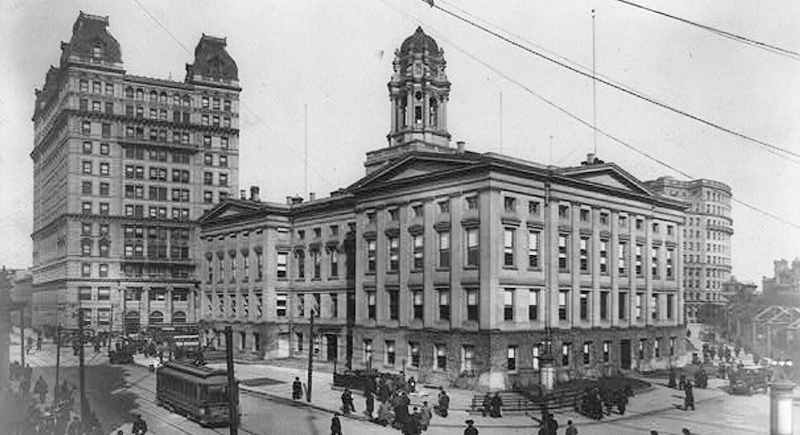
Image via Wikimedia Commons/Irving Underhill
On May 22, 1904, Jerry wandered into an office inside Borough Hall belonging to Judge Almet F. Jenks. Reports say a lit cigar had ignited papers on a desk, and fire could have spread quickly across wood furniture and paper files stored nearby.
Jerry rushed into the hallway and began howling loudly. Policeman Harry Staton reportedly recognized the behavior as unusual and followed the sound. Officers located the fire and extinguished it before major structural damage occurred. Some reports say they used an officer’s hat to carry water, while others mention early fire suppression tools. The exact method varies across accounts, yet all versions credit Jerry’s warning for the fire being caught early.
Local press treated the incident as proof of his value to the district, and after that day, his reputation changed. He was no longer viewed as just a familiar street animal, but was tied directly to protecting a major government building.
The Disappearance That Shocked Brooklyn
Late in 1904, Jerry vanished. Many locals assumed he had wandered off due to age, but months later, in April 1905, workers reopening a subway construction shaft discovered his remains. Reports linked the shaft to early transit expansion projects happening across Brooklyn at the time.
The reaction across the civic district was intense. The New York Times later published an obituary noting deep grief among city officials, lawyers, and business owners who had known him for years. Public figures even offered statements praising his intelligence and loyalty. Brooklyn produced many famous figures during that era, yet few earned loyalty across so many parts of city life the way one stray cat did.