Meet the Fuzzy ‘Yeti Crab’ That Survives in Underwater Volcanoes
Far below the ocean’s surface, beyond sunlight and far from conditions most animals could handle, lives a crab that looks like it showed up wearing a fur coat. Known as the yeti crab, this pale, bristly creature survives beside underwater volcanoes, where extreme heat and icy cold exist just inches apart. It sounds unreal, but this strange little crab is proof that life finds ways to adapt even when the environment seems completely unforgiving.
A Discovery Made in the Deep
The yeti crab entered the scientific record in 2005 during a deep-sea expedition in the South Pacific Ocean. Researchers exploring near the Pacific-Antarctic Ridge spotted clusters of unfamiliar white crabs tucked into rocky crevices close to hydrothermal vents. At depths of more than 7,000 feet, the pressure is extreme and there’s complete darkness.
The species was named Kiwa hirsuta. Kiwa comes from a Polynesian sea deity, while hirsuta means hairy in Latin. The nickname “yeti crab” stuck fast, thanks to the creature’s shaggy appearance and ghostly color. Since then, several related species have been identified in other deep-sea locations, including cold seeps and additional vent systems.
Life Next to Underwater Volcanoes
Hydrothermal vents form where molten rock rises beneath the seafloor and cracks the Earth’s crust. Superheated water loaded with sulfur, metals, and minerals bursts out, mixing with near-freezing seawater. These sites act like underwater volcanoes and create one of the harshest habitats on the planet.
For the yeti crab, survival depends on staying in a very narrow zone. Move too close to the vent, and the heat can be fatal. Drift too far away, and the cold becomes deadly. To stay put, hundreds of crabs crowd together, gripping rocks and sometimes piling on top of each other to avoid being swept away. In some locations, researchers have counted up to 700 yeti crabs packed into a single square meter.
Why the Crab Looks Fuzzy
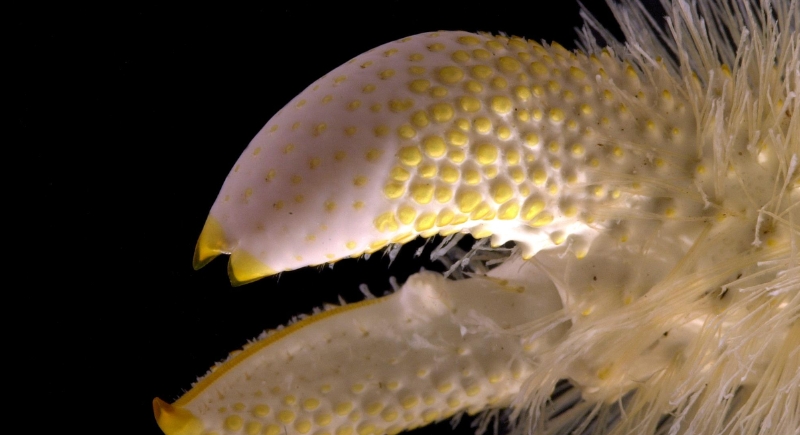
Image via Wikimedia Commons/Alexis Fifis
Despite appearances, the yeti crab is not covered in fur. The fuzzy coating comes from fine bristles called setae that grow along its claws and arms. These bristles serve a vital purpose.
The setae provide a surface where bacteria can grow. Near hydrothermal vents, bacteria feed on chemicals like hydrogen sulfide instead of sunlight. The crab waves its claws through the vent water, supplying the bacteria with the compounds they need to thrive.
Once the bacteria build up, the crab scrapes them off and eats them. It is a steady food source in a place where traditional prey is scarce. This bacterial farming system allows the crab to survive without relying on plants or photosynthesis.
Built for Darkness and Pressure
Yeti crabs are compact and muscular, reaching lengths of just under six inches. They are completely blind, which makes sense in an environment where light never reaches. Vision would offer little advantage, while energy saved by skipping eye development can be used elsewhere.
Their strong claws help them hold position against shifting currents and cling to rocky surfaces near vents. While bacteria make up a major part of their diet, yeti crabs have also been observed feeding on mussels and other vent-dwelling animals when the chance arises.
A Narrow Margin for Survival
Image via Canva/Kichigin
Living beside underwater volcanoes is a constant balancing act. Crabs must manage heat, cold, pressure, and limited space simultaneously. Their crowded behavior is not social in the usual sense. It is practical.
Staying together helps them remain within the safe temperature range and close to their bacterial food supply. This tight living arrangement highlights how little room for error exists in deep-sea vent ecosystems. A switch in vent activity or water flow can quickly change conditions.
The yeti crab shows how life can flourish in places once thought uninhabitable. As exploration technology improves, more species like this fuzzy crab are likely waiting to be found. It’s a reminder that Earth still holds surprises.