Meet the Rare Species That Can Survive a Lifetime Without a Single Sip of Water
The human body cannot survive long without water. After just a few days, concentration slips, organs begin to strain, and survival becomes a matter of hours rather than days, rather than comfort. Most animals face similar limitations, congregating around rivers and watering holes to survive the hot, dry seasons.
In parts of East Africa, one mammal has taken a different path. The gerenuk lives almost entirely without drinking, which shapes its life around dry heat and scarce resources. It feeds on moisture-rich leaves that many animals ignore, moves easily through arid landscapes, and avoids the constant competition that surrounds open water. Often called the giraffe gazelle, it has turned survival without a sip into a lifelong strategy.
Built For Heat, Not Water
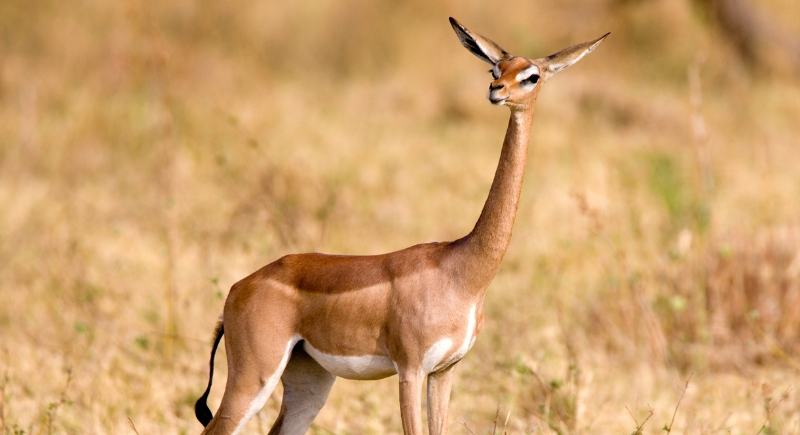
Image via Getty Images/pjmalsbury
The gerenuk can look slightly unusual at first glance. Its long neck rises above a slim body, finished with a small head and wide, alert eyes and ears. That shape answers a simple challenge in dry regions. Much of the available food grows higher up, beyond the reach of animals feeding closer to the ground.
Rather than grazing, the gerenuk focuses on browsing. It reaches for leaves, flowers, and shoots that other antelope leave behind. By rising onto its hind legs, it stretches upward and draws branches closer with its forelegs. This position allows it to feed at heights of up to approximately 6.5 feet, supported by strong hind limbs and reinforced lower vertebrae that maintain a steady and efficient posture.
Hydration By Design
Gerenuks never rely on surface water. Every drop they need comes through food. Their diet focuses heavily on moisture-rich plants, including succulents and tender leaves that store water even during dry seasons. Research cited by the African Wildlife Foundation estimates that their diet includes around 80 plant species, many of which are chosen for their high water content rather than volume.
Internal systems reinforce that advantage. Specialized nasal passages limit moisture loss during breathing, highly concentrated urine conserves fluid, and activity levels stay low outside short bursts used to avoid predators. Energy use stays controlled, which reduces overall water demand.
Living farther away from permanent water sources also helps. Aerial surveys in northern Kenya show higher gerenuk densities in the driest areas, especially locations distant from rivers and springs. That spacing reduces competition with other browsers that still need to drink.
Selective Eating As a Survival Strategy
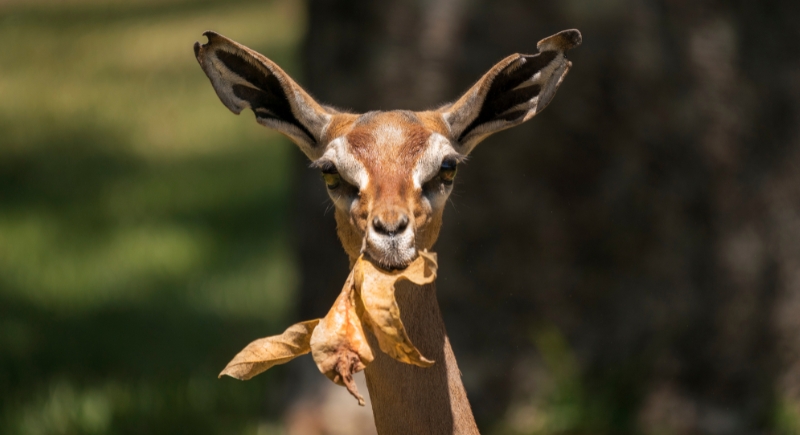
Image via Getty Images/Gypsy Picture Show
Calling the gerenuk a picky eater misses the point because selectivity keeps it alive. It does not sample broadly or graze opportunistically; it commits to specific plants that deliver hydration and nutrition simultaneously. That approach shapes behavior and social patterns. Gerenuks usually travel alone or in small groups of two to five. Larger gatherings appear only during brief periods when vegetation flushes after rain. Remaining dispersed limits pressure on food sources and reduces the need to travel long distances.
An Advantage Under Pressure
Fewer than 100K gerenuks remain, based on recent population estimates. Numbers dropped by roughly 25 percent over the past 14 years, and habitat loss plays a central role. Expanding settlements, fencing, and land conversion shrink the dry scrub environments where their food plants grow.
The same specialization that keeps gerenuks alive without water also narrows their margin for error. When preferred vegetation disappears, alternatives rarely offer the same hydration value. Unlike other antelopes, they cannot pivot easily to grasslands or water-dependent feeding routes.