Science Says Dogs Learn Words Exactly Like Human Toddlers Do
For years, researchers have known that young children pick up words just by being around conversation. Toddlers do not need lessons or direct instruction. They listen, watch, and slowly connect sounds to meaning as the world unfolds around them.
New research suggests some dogs learn in the same way. A study published in Science in January 2026 found that a small group of dogs with unusually large vocabularies can absorb word meanings simply by overhearing human speech. No commands, no pointing, no deliberate training.
These dogs form word–object links through the same ingredients that help 18-month-old children learn language: repeated exposure, social context, and attention to how people interact with objects. Hearing a word used naturally, watching what it refers to, and experiencing it again and again is enough for the association to stick.
The findings focus on dogs that already show exceptional language skills, but they challenge a long-held assumption that this kind of learning is uniquely human. At least for some dogs, understanding words seems to come from listening first, not being taught.
Dogs With Unusually Large Vocabularies

Image via Getty Images/Pixsooz
Most dogs recognize a familiar set of words tied to routines and actions. The dogs involved in this research demonstrate a different capability. Known as Gifted Word Learners, they can recognize dozens, and sometimes hundreds, of individual objects, most often toys. Some retrieve the correct item on request years after first learning its name.
These dogs were raised in typical household environments. Their owners contacted researchers after observing consistent responses to object names during everyday play. Border Collies were frequently represented in the sample, along with other breeds, suggesting that this ability emerges across different genetic backgrounds.
To examine how these dogs learn, researchers adapted experimental designs used in toddler language studies. In early childhood research, new words are often introduced indirectly, such as when adults talk to each other while handling unfamiliar objects. Children learn by tracking gaze, monitoring attention, and identifying key words within flowing speech.
The research team applied the same structure to dogs with advanced vocabularies.
Learning Through Observation
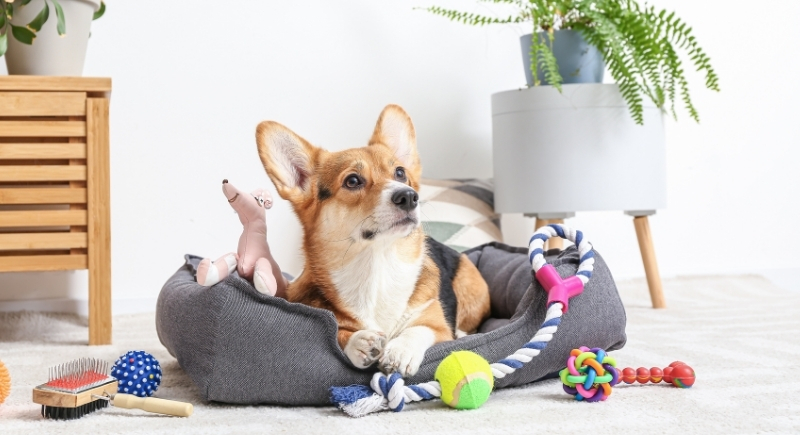
Image via Canva/pixelshot
In one phase of the study, owners introduced new toys through short, repeated play sessions, speaking the toy names naturally. This confirmed that the dogs could form new object-label associations through direct interaction.
In a second phase, the setup changed. Dogs remained nearby while their owners spoke to another person. The toy was passed back and forth, and its name naturally came up in conversation. The dogs observed these interactions over several days.
When tested later, the dogs successfully retrieved the correct toys by name from a group that included familiar objects. The learning occurred through exposure to third-party interaction rather than direct engagement.
Another variation explored whether dogs could form word–object associations when labels and objects were separated in time. Owners briefly showed a toy, placed it out of view, and then spoke its name in conversation.
Many of the dogs identified the correct objects during later testing. Follow-up trials conducted two weeks later showed that the associations remained intact, indicating lasting memory formation.
A Rare Cognitive Profile
To understand how widespread this ability might be, researchers tested typical family dogs using the same overhearing setup. These dogs showed interest in new toys but did not consistently associate spoken labels with specific objects.
This contrast highlights the specificity of the Gifted Word Learner profile. The findings apply to dogs with an established history of object-name learning, not the general dog population.
Dogs have coexisted with humans for thousands of years, adapting to environments shaped by speech, gesture, and social exchange. Their sensitivity to attention, gaze, and communicative context reflects this shared evolutionary history.
The study demonstrates that the cognitive systems supporting word learning extend beyond humans. These systems likely existed before spoken language emerged and were later refined within human development.