Scientists Discover That Octopuses Sometimes Punch Fish With No Reason at All
Scientists have recently documented a behavior that looks almost comedic at first glance: an octopus suddenly reaching out and striking a nearby fish. Divers have filmed these moments in detail, and the recordings left researchers sorting through what the interactions actually mean. The question isn’t whether an octopus is capable of the move, but why it does it in situations that seem unpredictable or unnecessary.
A Hunting Team With Complicated Chemistry
Day octopuses, usually known for camouflage and solo missions, team up with several reef fish species to hunt. Scientists filmed more than 100 hours of these partnerships in the Red Sea and logged behavior during 13 full hunts. Groups often include blacktip groupers, blue goatfish, and other reef fish that help locate prey. The fish find potential meals. The octopus reaches into tight crevices and flushes prey out. Everyone benefits when the group stays active.
That balance falls apart when certain fish act like freeloaders. Blacktip groupers move slowly and wait for prey to come to them, which stalls the group. Researchers noticed that they receive most of the hits. The octopus doesn’t swing wildly. It targets the fish that hold everything up. The punch acts like a quick correction that gets the group moving again.
Odd Moments
The part that captivated researchers is that not every punch has a clear purpose. Some hits happen when no prey is in sight, and no fish is blocking the hunt. These scenes appear in earlier field footage as well as recent work published in major scientific journals. A fish swims near the octopus. Nothing seems wrong. Then the octopus fires a sharp arm extension straight at the fish, and both animals continue as if that were a normal Tuesday.
One explanation is partner control. If the octopus invests energy by reaching into crevices while fish benefit from the catch, the octopus may occasionally enforce the relationship. But the footage also includes situations where the hit leads to no clear advantage. This opens the door to another interpretation supported in earlier research: some strikes look like pointless aggression. Not full conflict, not competition for food, just a sudden action that leaves the fish confused.
A Glimpse Into Complex Minds
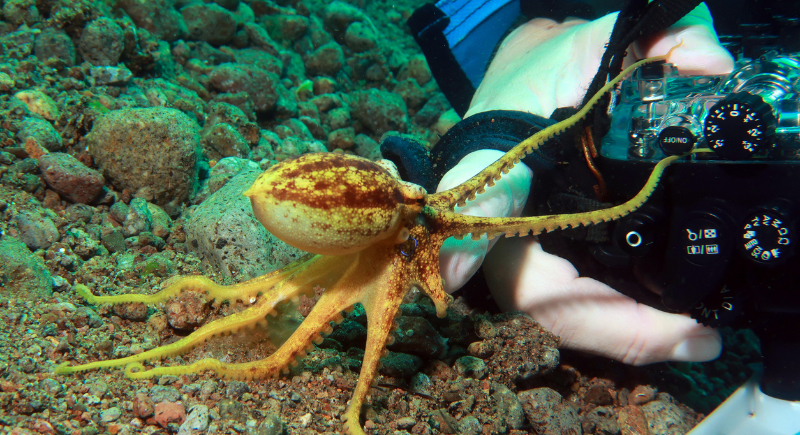
Image via iStockphoto/Olga Oginskaya
Experts studying octopus behavior see these moments differently. Some focus on teamwork. Data gathered through multi-camera tracking shows that certain fish lead the direction of the group while the octopus keeps the momentum. When the group slows down, the octopus encourages movement. That maps onto the enforcement theory.
Other specialists aren’t convinced. They argue that octopuses behave more like underwater bulldozers, disturbing sand and rock while searching for prey. Fish may simply follow the disturbance to score their own meal. In that interpretation, the octopus isn’t enforcing teamwork. It’s just reacting when a fish gets too close or interrupts its search.
Both positions agree on one point: the behavior is consistent, visible across multiple hunts, and puzzling enough to spark new questions. Does the color shift to black and white serve as a warning? Do octopuses recognize individual fish, especially long-lived species like groupers? Do they favor certain partners? Researchers tracking these hunts have started asking exactly that.
Each punch, purposeful or random, hints at a more social and flexible animal than many expected. Field studies show that day octopuses display coordination, quick decision-making, and reactions that vary by context. Smaller octopuses also appear to struggle with group hunting more than large ones, suggesting that this skill may develop over time.
The underwater footage doesn’t settle every debate, but it confirms that octopuses aren’t just clever loners. Scientists plan to keep filming, measuring, and mapping each encounter until the mystery becomes clearer. For now, the ocean keeps the secret, and the fish keep watching their backs.