Scientists Finally Figured Out Why This Fish in Washington Looks Like a Zombie
The rockhead poacher is a small fish found along the Pacific coastline, including Washington waters, and it has one of the strangest skulls ever documented in a vertebrate. A large, circular pit sits in the center of its head, deep enough to appear like a missing bone rather than an anatomical feature.
Scientists have known about this feature since the late 1800s, yet no explanation has made sense. However, recent anatomical scans have finally ended a mystery that lasted more than a century by clarifying what the structure is and why it exists.
A Head That Should Not Exist

Image via Facebook/Oregon Coast Aquarium
The rockhead poacher measures about 3.5 inches long and spends much of its life pressed against stone in tide pools and narrow crevices. Heavy bony armor covers the body, while the head contains a wide, bowl-shaped pit that drops deep into the skull. No other known vertebrate has a structure like it, which made the fish unusual to biologists from the start.
The feature puzzled researchers for decades. Early theories focused on camouflage, pressure sensing, or enhanced hearing. Each explanation addressed part of the structure but failed to fully describe its shape, depth, and placement. The study remained limited because the fish is difficult to locate and hard to observe for long periods.
An Interesting Discovery
The breakthrough came after a detailed internal scan of preserved specimens using high-resolution microCT imaging. That work took place at Louisiana State University and focused on mapping the skull without cutting it open. The scans revealed that the cranial pit contains fine bony spines, nerve pathways, and a thick, rigid base.
More striking was that the first pair of ribs appeared unusually large, flattened, and positioned directly below the pit. These ribs were not attached to the spine. Instead, muscles and tendons controlled them independently. That layout suggested deliberate movement.
Built to Make Noise
Fish communicate in many ways, and sound plays a major role in this. The rockhead poacher already had a reputation for buzzing vibrations when handled underwater, and the new scans offered a mechanical explanation. The ribs function as drumsticks, and muscular contractions drive them upward, striking the bony plate beneath the cranial pit.
Each impact sends vibrations through the skull and into the surrounding rock. The pit amplifies the signal, acting like a resonating chamber rather than an empty defect. This turns the fish’s head into a built-in percussion system.
The Sound Travels Through Stone
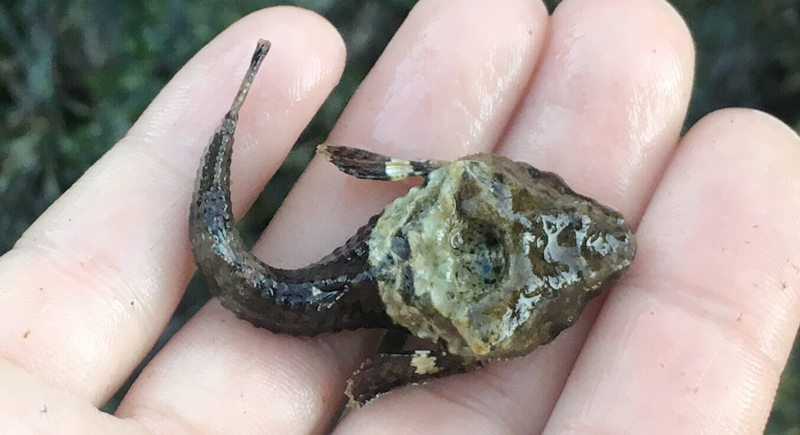
Image via X/Adam P. Summers
The habitat explains why this works for the fish. Shallow intertidal zones are loud; waves crash, rocks grind, and water churns nonstop. Sound in water becomes difficult to pinpoint and easy to drown out. Vibrations moving through solid ground behave differently. Rock transmits low-frequency signals faster and with less distortion than seawater.
By sending vibrations downward instead of outward, the rockhead poacher avoids the acoustic chaos above it. This method likely helps with territory warnings, mating signals, or deterrence. The cranial pit probably does more than produce sound. Nerve tracts within the cavity connect to motion-sensing systems that fish use to detect changes in water flow. That suggests the structure also works as a sensory tool, helping the fish track nearby movement.
Proof Still in Progress
Scientists have not yet recorded the drumming behavior in the wild. The anatomy makes the function plausible, and live specimens vibrate noticeably when disturbed. Underwater microphones placed near tide pools could provide the final confirmation.
The lead researcher on the work, Daniel Geldof, describes the species as living inside constant noise while still needing a clear way to communicate. The solution does not rely on volume, but on direction. After more than a hundred years of speculation, the rockhead poacher no longer looks like a biological mistake. The hollow in its head reads less like damage and more like design.