Scientists Find a Tree Kangaroo for the First Time in 90 Years
Scientists documented the Wondiwoi tree kangaroo once, in 1928, after a brief encounter during an expedition in what is now West Papua, and then lost track of it for the next nine decades. No confirmed sightings followed, and no photographs existed. Research relied on a single preserved specimen and aging field notes.
As years passed, the species drifted into a gray zone where extinction felt likely but unproven. Its known habitat sat in a remote mountain range with little scientific access, which only deepened the uncertainty. By the early 21st century, the animal had become one of the least understood mammals ever recorded. Then something changed in a mountain range that few outsiders ever reach.
The Climb Irrelevant at First

Image via Canva/annastills
The rediscovery started with plants. While surveying the Wondiwoi Mountains, amateur botanist Michael Smith followed his usual method, hiking remote ridges that rarely appear on research maps. At elevations between about 4,900 and 5,600 feet, signs began to stand out.
Tree trunks showed deep claw marks. The ground held fresh scat. A strong musky smell hung in the air. Together, these pointed to a large, active animal moving through the trees.
The key moment came near the end of the hike. High in the canopy, roughly 90 feet above the ground, a large animal moved across the branches long enough for Smith to capture it on camera.
Solid Proof
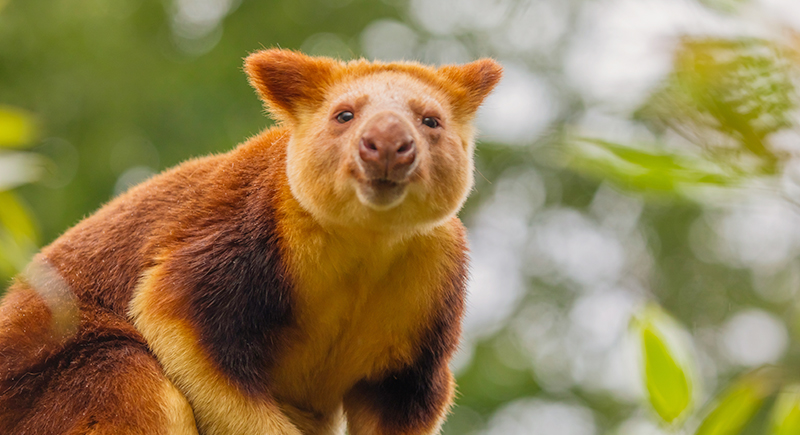
Image via iStockphoto/Elen Marlen
Those images ended decades of speculation in one stroke. Experts who examined the photos focused on coat color and body shape, details that matched the long-archived specimen exactly. The Wondiwoi tree kangaroo wasn’t hiding across a wide region. It was holding on inside a narrow pocket of high-altitude forest.
That isolation explains both the disappearance and the surprise. Local hunters rarely climb beyond lower elevations where bamboo thickens, and travel slows to a crawl. Scientists hadn’t pushed much higher either. The animal didn’t vanish. Human attention simply stopped short.
Why Rediscovery Brings New Risks
Confirmation brings relief, yet it also resets the clock. A species confined to an area estimated at just a few dozen square miles lives with little margin for error. Logging, hunting pressure, and proposed mining projects now carry a heavier weight. Conservation groups see an opportunity here, especially inside protected park boundaries. Data collection, habitat monitoring, and genetic testing can finally proceed, and for scientists, the find proves patience still pays off.
There’s also a broader lesson tucked into this moment. Even in 2018, with satellites overhead and biodiversity maps filling databases, entire mammals can still slip through the cracks. The Wondiwoi tree kangaroo survived because its world stayed difficult to enter. That same difficulty now shapes its future.