
Before the barking even starts, watch what happens at the gate: it's the quickest clue to who's going to talk more.
The first 48 hours: why the hallway gets so loud
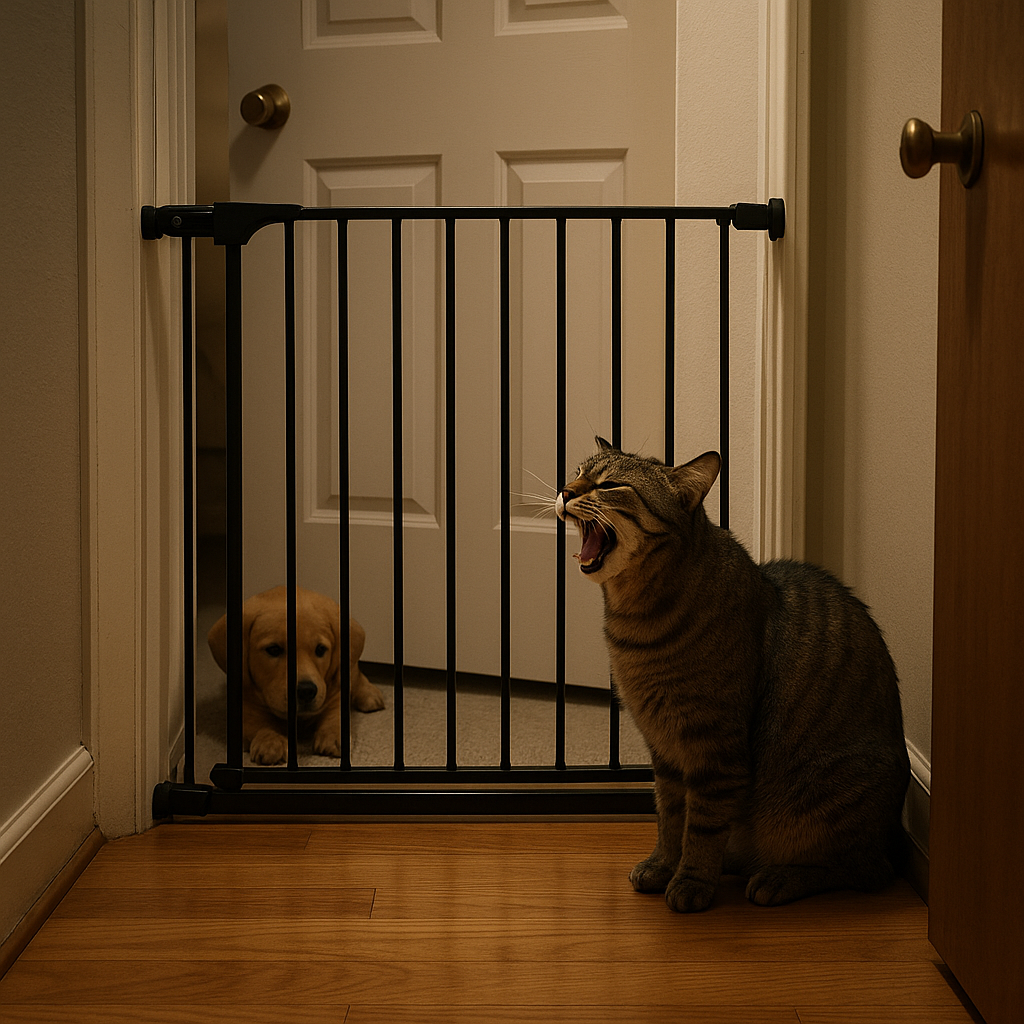
When a new pet comes in, the house map changes overnight. Even if you do everything by the book (separate rooms, slow intros, feeding on opposite sides of a closed door), the resident cat suddenly has a soundtrack they can't control. That's where the surprise vocal spike tends to show up: not during the dramatic moment you pictured, but at 2:17 a.m. when the new dog whines in the crate, or when the new kitten scrabbles at the baseboard behind the closed bedroom door. Your cat isn't being "jealous" in the cartoon sense. They're running a constant roll call: Who's moving? Where? Are they coming toward my litter box? Toward my food? Toward my nap spot behind the sofa?
I learned to pay attention to the hallway because it's the choke point. Doors are closed, everyone is separated, and yet scents and sounds leak under the gap. If your cat starts doing that long, echo-y meowl that sounds like they're calling for someone, it's often frustration plus uncertainty. They can hear the newcomer, they can't see them, and they can't do the normal cat thing of walking over, sniffing, and deciding what folder to put this creature in. Add your own routine changes (you sleeping with one ear open, moving bowls, camping out in the "new pet" room), and you've basically told your cat: the schedule is negotiable now.
Two tiny, practical things have helped me more than pep talks. First, I make the resident cat's essentials annoyingly consistent: same feeding times, same scoop schedule, same spot for the scratching post they use every morning. Second, I use sound on purpose. If the newcomer is noisy at night, a white noise machine outside the resident cat's door can blunt the startle factor, and it stops the pattern where your cat learns that yowling is how we all do midnight roll call now. The point isn't silence. It's predictability.
Scent layering beats forced introductions
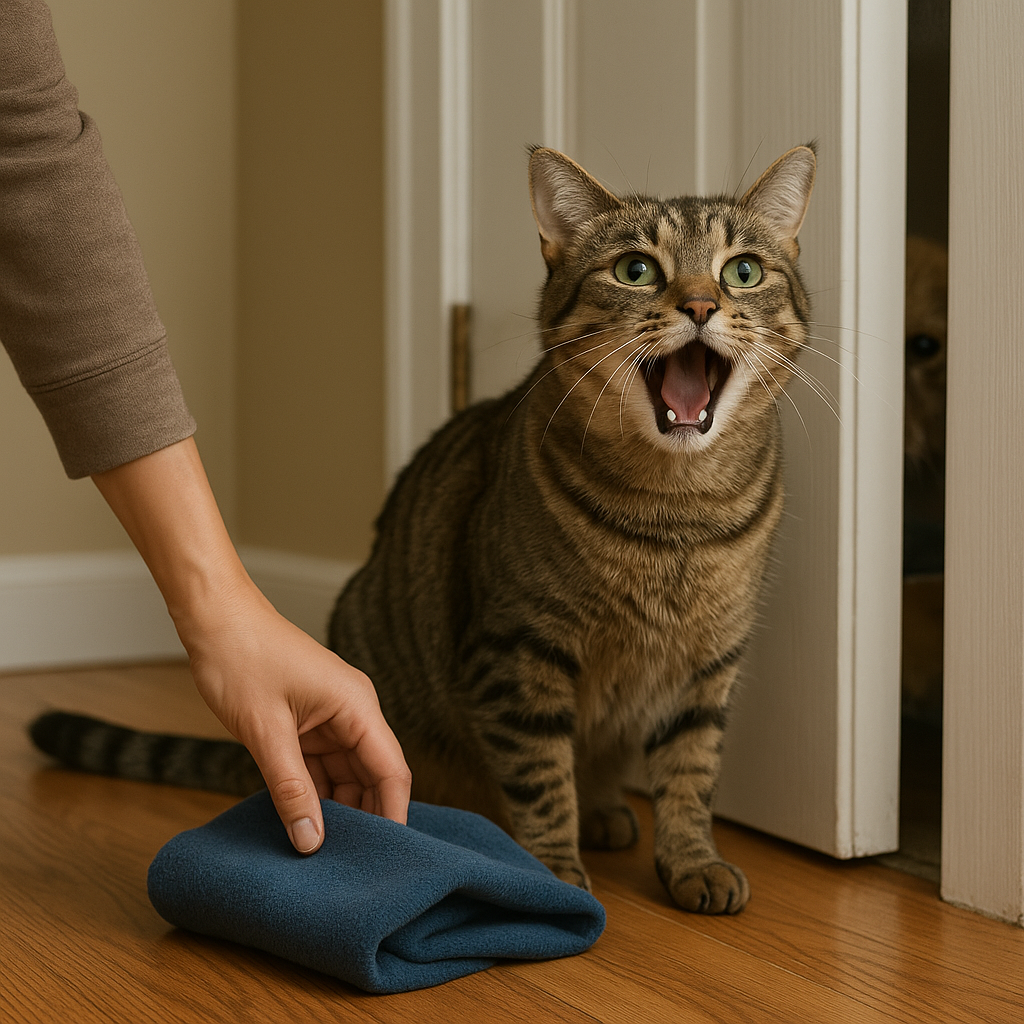
If there's one place the extra meowing comes from, it's the mismatch between what your cat's nose already knows and what their eyes are allowed to confirm. A new pet is basically a walking cloud of information: fur, saliva, litter dust, whatever food they're eating, whatever shampoo the shelter used. When you keep them separated (which you should at first), your cat gets the scent updates without the normal follow-through. That tension can spill out as pacing plus loud, repetitive calls, especially around doors and vents.
Scent work is the least glamorous part of bringing in a new animal, but it's the part that has consistently lowered the volume in my house. I don't do a big swap and expect miracles. I layer it. A small blanket the new pet slept on goes near (not on) the resident cat's favorite nap spot, like the edge of the cat tree base or beside the radiator bed. If the cat sniffs and walks away, great. If they sniff and start chattering or meowing, I back it up a few feet the next round. Same idea with a soft brush: one brush for each animal at first, then after a few days I'll rub a clean cotton sock on the new pet's cheeks and shoulders (where the friendlier facial scent lives) and leave it near the resident cat's scratching post. Scratching plus sniffing is a strong combo. It's how cats file things as familiar.
Food helps, too, but not as a bribe. I feed high-value stuff (Churu-style lickable treats work well) while the resident cat is smelling the newcomer through a door crack, so the scent shows up in a predictable, non-threatening moment. I avoid doing it when everyone's already ramped up. If you wait until there's hissing and yowling, you're pairing the new smell with chaos and then wondering why your cat starts announcing their feelings every time you walk toward that room.
This is also where you can accidentally create a vocal routine: you hear a dramatic meow at the door, you rush over, you talk, you open it a bit, you negotiate. Your cat learns the door is the stage. Keep the swaps boring and frequent, and save your attention for calm seconds. It doesn't feel like much, but after a week you often get a quieter house and a cat that sniffs, blinks, and goes back to being busy with cat business.
How I tell stress-meows from attention-meows
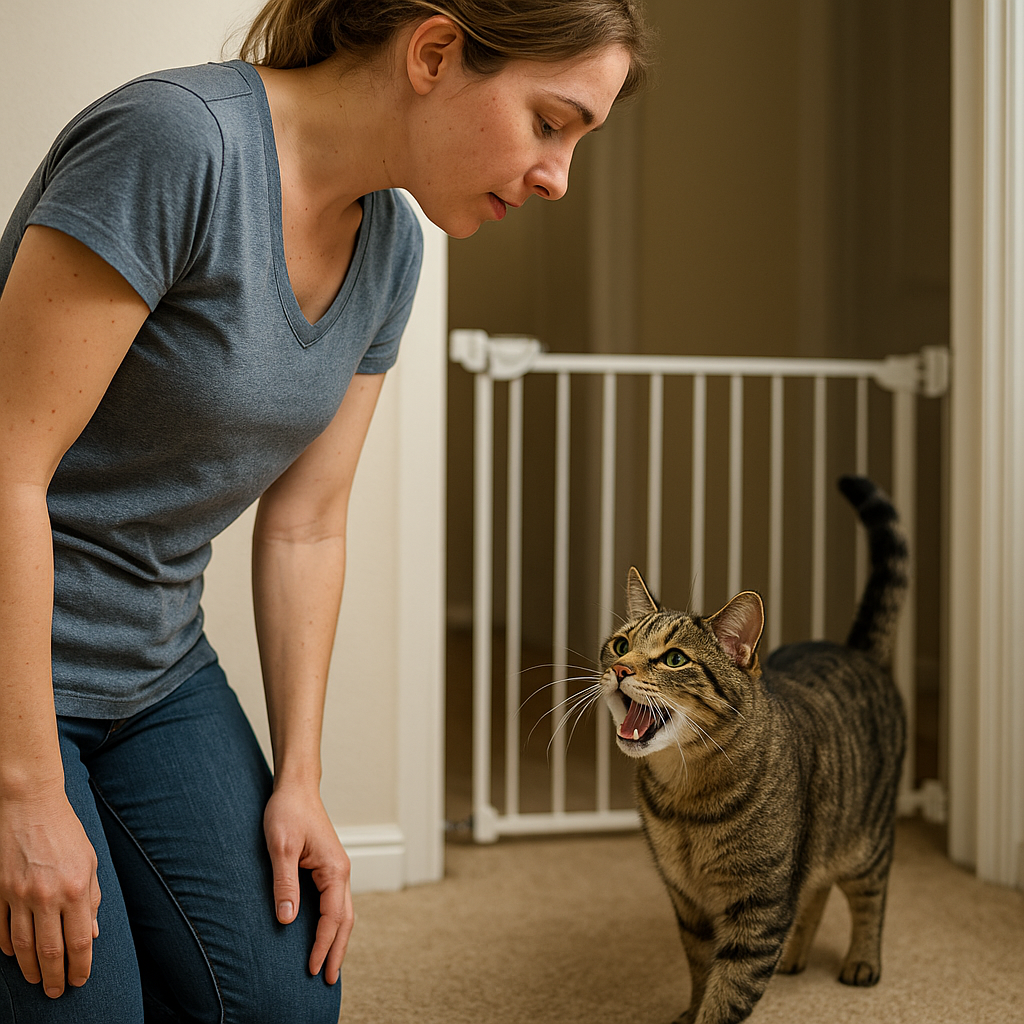
Once a new pet is in the mix, it's easy to treat every extra meow like it's the same problem. It isn't. Some of it is plain attention (you've been busy, routines are off, and your cat has noticed). Some of it is the cat equivalent of shouting updates into the void because they feel boxed out of parts of their own home. The difference matters, because if you respond the same way to both, you can accidentally teach your cat to narrate every moment of the introduction process at full volume.
Here's what I watch, in order, because it's hard to hear nuance at 6 a.m. when someone is yelling from the hallway. If the meow comes with a loose body, upright tail, and the cat is trotting toward you with that friendly little head-butt angle, I'm not worried. That's a where have you been complaint, and giving them two minutes of direct interaction (brush, lap, a wand-toy session that ends with a small meal) usually takes the edge off. On the other hand, if the sound comes with ears rotated sideways, a twitchy tail tip, and the cat keeps looking past you toward the closed door where the newcomer is, I treat it as stress noise. In my house, those meows are also more repetitive, like the cat is stuck on one phrase.
I also look at where it's happening. Attention-meows follow you. Stress-meows anchor to locations: the baby gate, the threshold, the corner where the new pet's carrier sat, the spot by the litter box if access has changed. If your cat is posted up by the gate and calling while staring through it, don't fix it by doing a bunch of talking at the gate. That turns the gate into the biggest, juiciest place in the house. Instead, I move the action away from the boundary. I do a feeding station a few feet back from the gate, then gradually closer over days, and I make sure the resident cat has at least one new pet free perch where they can watch without feeling trapped.
If the vocalizing is new and intense, or you see appetite changes, litter box changes, or hiding that lasts beyond a couple of days, that's when I stop guessing and call the vet. Stress can pile up fast during introductions, and I don't want to miss a medical issue because I assumed every meow was just about the newcomer. But for the day-to-day stuff, this simple sorting (following you vs anchoring to a boundary) keeps me from reinforcing the loudest behavior by accident.