The Controversial New Trend That Lets People Buy a Copy of Their Dog
Losing a pet can rearrange your life in ways you don’t expect. Some people adopt again. Others wait and let the house feel empty for a while. And a growing number look for comfort somewhere very different.
Tom Brady pushed that conversation into the spotlight when he shared that his dog Junie is a clone of Lua, the pit bull mix he lost in 2023. The reveal didn’t just spark curiosity; it tapped into a familiar ache. For many owners, the idea that a piece of a loved pet might return feels tempting on a level that’s hard to put into words.
Celebrity choices tend to shape the headlines, especially when names like Barbra Streisand talk about cloning their dogs. But the practice has moved well beyond famous owners.
Viagen Pets & Equine, the only American company offering this service, now keeps a months-long waitlist and charges fifty thousand dollars for a cloned dog or cat. The cost makes it sound like a luxury niche, yet the impulse behind it isn’t about wealth. It’s about people trying to hold on to something they’re afraid to lose twice.
A Growing Business Built on Heartbreak
Some of the most devoted cloning clients aren’t wealthy at all. They are people who feel such a strong connection to their pets that they are willing to trade prized possessions or drastically adjust their lifestyles to recreate even the possibility of that bond.
Hair stylist Roberto Novo adored his French bulldog, Machito, so deeply that when Machito died unexpectedly, he sold a treasured Andy Warhol silkscreen to pay for cloning. When he heard that a healthy clone named Machitwo had been born, he said the weight of his grief lifted in a way that he hadn’t expected.
Former police officer John Mendola shared a similar experience after losing his Shih Tzu mix Princess. He gave up his Lexus for a cheaper truck, cut expenses everywhere he could, and saved aggressively so he could clone her. His effort resulted in two puppies, Princess Jasmine and Princess Arielle, and he says their little habits often remind him of the original Princess in ways that feel both familiar and comforting. Stories like these explain why people are willing to stretch themselves financially, even when friends and family don’t fully understand the decision.
The Science and the Hidden Costs
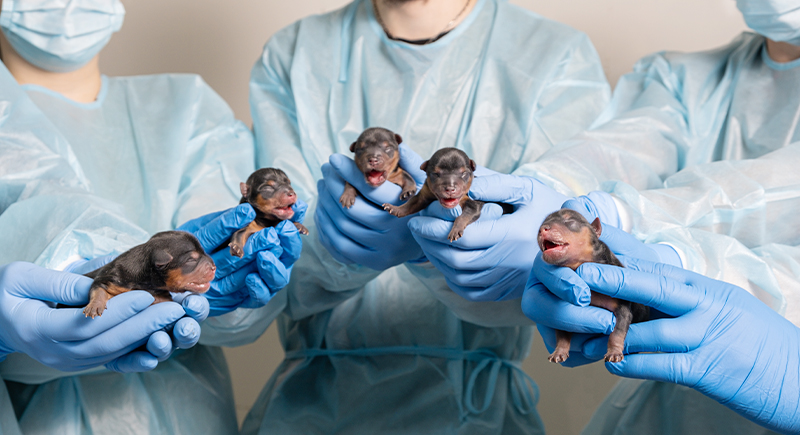
Image via iStockphoto/Maliev Oleksandr
The idea of cloning might sound straightforward, but the science behind it is layered and still imperfect. The process uses somatic cell nuclear transfer, which is the same approach used to create Dolly the sheep. Scientists take cells from the original pet, insert that DNA into a donor egg, grow the embryo in a lab, and then place it into a surrogate animal for pregnancy.
What sounds clean in theory becomes much more complicated in practice. A 2022 study cited in recent reporting found that only about 2 percent of cloning attempts in a sample of 1,000 dogs resulted in a living puppy. Early cloning efforts required massive numbers of donor eggs and surrogate animals, and even now, companies often implant several embryos at once to increase the chances of producing just one healthy pup.
Even when cloning works, experts remind people that a cloned dog will not behave exactly like their original companion. Mitochondrial DNA from the surrogate and the influence of environment, socialization, and timing all shape personality, so you may get an animal that looks strikingly similar but acts very differently. It’s not a recreation of the past so much as a new dog with familiar genetic starting points.
The Debate Over What’s Right
Animal welfare groups like PETA and the RSPCA argue that cloning is unnecessary and potentially harmful, because the process relies on surrogate animals whose well-being can be difficult to monitor fully. At the same time, shelter advocates point to the staggering number of dogs and cats that never find homes.
In 2024, over 748,000 shelter animals in the United States had non-live outcomes, and workers say that for a few hundred dollars, people can adopt a pet that comes already vaccinated, microchipped, and spayed or neutered.
Supporters of cloning counter that the emotional bond between a person and their pet is so strong that the option to clone can offer a sense of comfort during grief. Some also note that the same technology is being used by scientists to help endangered species like black footed ferrets and Przewalski’s horses. Still, even the experts working on conservation efforts admit that cloning solves only a tiny sliver of the larger problem.
The trend sits in a complicated space where grief, science, hope, and ethics all collide. For some grieving pet owners, cloning feels like a meaningful second chance. For others, it raises questions about what we owe the animals already waiting in shelters. What’s clear is that buying a copy of your dog is no longer a sci-fi idea. It’s real, it’s expensive, and it isn’t going away anytime soon.