
That side-step in the narrow hall isn't random. It's a tiny piece of herding logic, and you can see it all day once you know where to look.
The hallway pinch point is where the instinct shows up
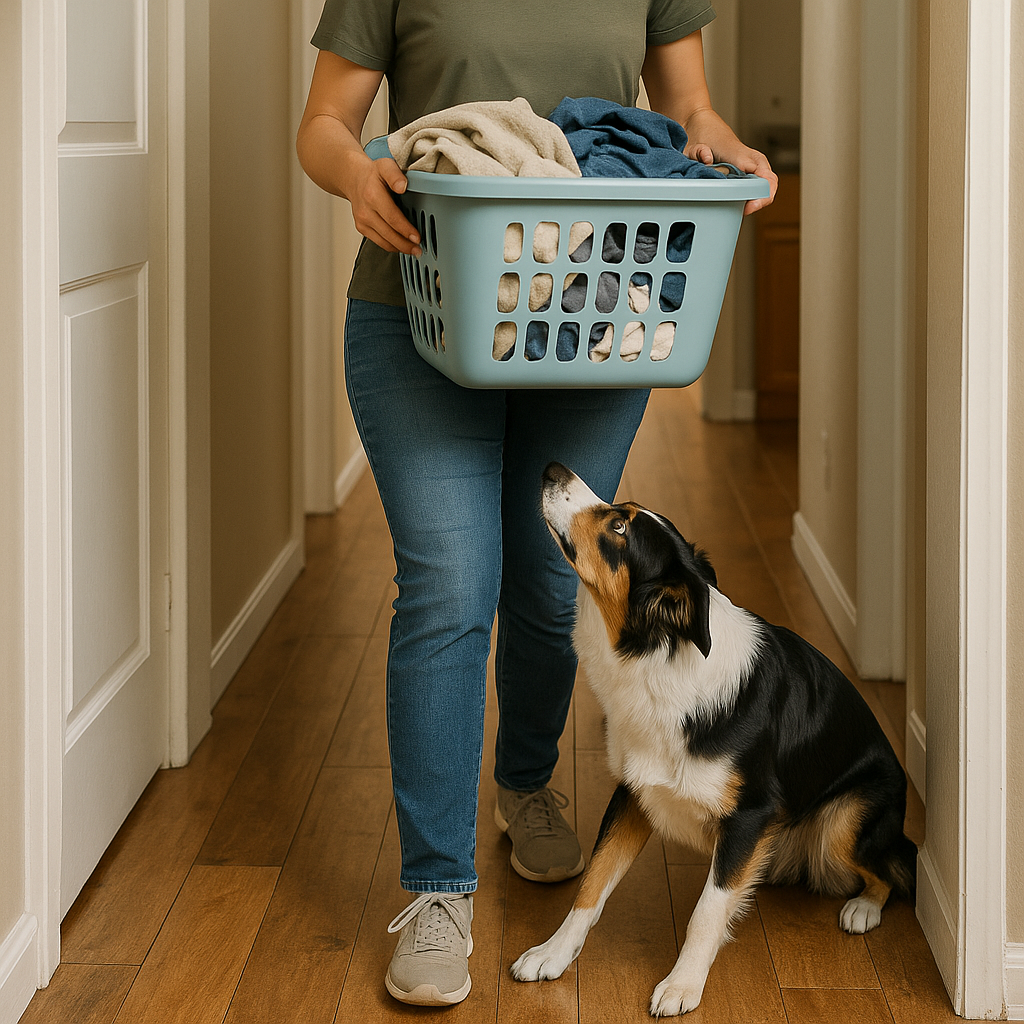
The first time I realized my dog wasn't being clingy, I was carrying a laundry basket down a narrow hall. He slid out of a doorway, angled his body like a little furry bouncer, and funneled me toward the kitchen instead of letting me pass to the bedroom. No bark, no growl, no training cue from me. Just a calm, purposeful block and a quick glance at my feet, like my shoes were the part that mattered. If you live with a herding breed, watch what happens at pinch points: the hall between bedrooms, the gap between the couch and the coffee table, the doorway where two people can barely pass. Those are the spots where movement becomes predictable and controllable, and that predictability seems to flip on the instinct.
In open spaces, people scatter. In a hallway, everyone becomes a line. A herding dog doesn't need a flock for that to make sense. A toddler running laps, a roommate heading to the front door, you coming back from the garage with an Amazon box, all of it has a direction, a pace, and a place it can be cut off. That's why the behavior often looks like "guarding" to someone who's never lived with it. But the body language is different. You'll see a sideways stance, a shoulder presented, and that signature little dart of the eyes to ankles and knees. Some dogs add a quick nose touch to your calf. Others do the silent cut-off and then trot ahead to get in front again, as if you might forget where you're supposed to go.
What makes it feel uncanny is how consistent it is. Mine doesn't do it when I'm sitting still. He does it when I'm moving with purpose, especially if someone else in the house is also moving. Two humans crossing paths in a hallway is basically a mini sorting job. If your dog tends to orbit, pace, or block when the household gets busy, try paying attention to the layout instead of the mood. The behavior spikes in tight corridors and around doorframes because those are the easiest places for a dog to control speed and direction without escalating. It's not a moral failing. It's geometry meeting instinct.
Why ankles get targeted instead of faces
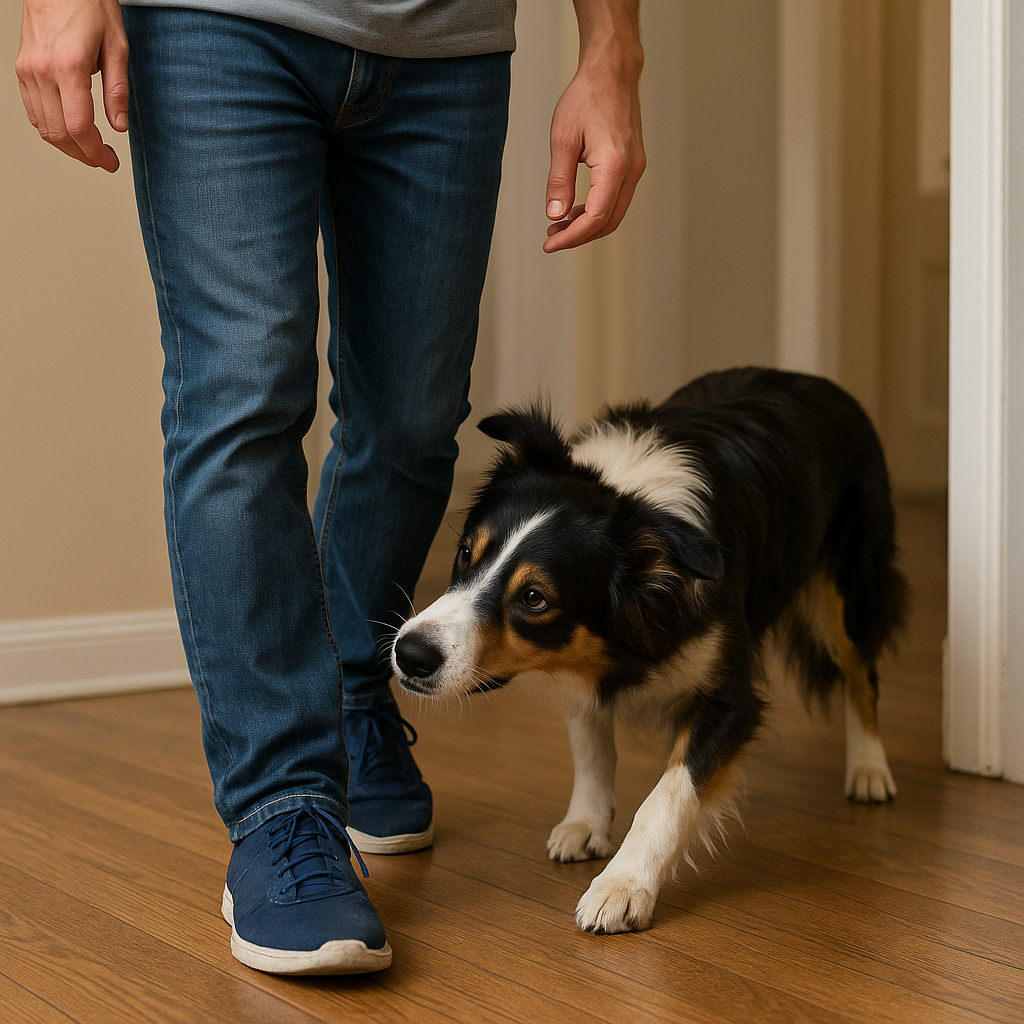
When people tell me, "He goes for my ankles," they usually say it like the dog is picking a fight. But ankles are the steering wheel. If you stop the feet, you stop the whole plan. Herding breeds are built to work from behind and to the side, and their whole toolkit is about changing motion with the smallest possible pressure. That's why the contact, when it happens, is often a fast tap, a dart-in-and-out, or a near-miss that makes you hesitate for half a second. That half second is the point. It's the dog creating a pause so the moving thing can be redirected.
You can see the same logic in the way they use space. My dog will drift behind me when I'm headed to the stairs, then swing to my outside leg, like he's trying to keep me from splitting away from the route. If I pivot suddenly, he pivots with me and tries to get to the new "back" position. It's less about guarding a room and more about managing flow. Feet are the easiest place to apply that management, because humans reflexively adjust when something appears near their shoes. We don't think, we just slow down, step over, or change direction. The dog gets a clean result without needing force.
If you want to understand why it shows up without formal training, watch what triggers it. Quick, jittery motion is basically a big neon sign. Kids in socks sliding on hardwood, someone jogging in place during a Peloton warmup, a friend doing that bouncy hello at the front door. Even a Roomba can set it off because it moves with stubborn intent and never reads the room. The dog isn't making a considered decision about rules. It's responding to movement that looks like a break in the pattern, the way a sheep peeling off the group would.
The tricky part is that humans often accidentally reinforce it. We squeal, we hop, we speed up, we chase. To a herding brain, that reaction confirms the job is working. If you're dealing with actual nipping, that's where a qualified trainer can help you build a plan that prioritizes safety and gives the dog a different, rehearsed behavior. But even before you get there, it helps to reframe what you're seeing: your dog is aiming for the part of you that controls direction, because that's literally how the work is done.
When the whole family stands up, they try to gather you
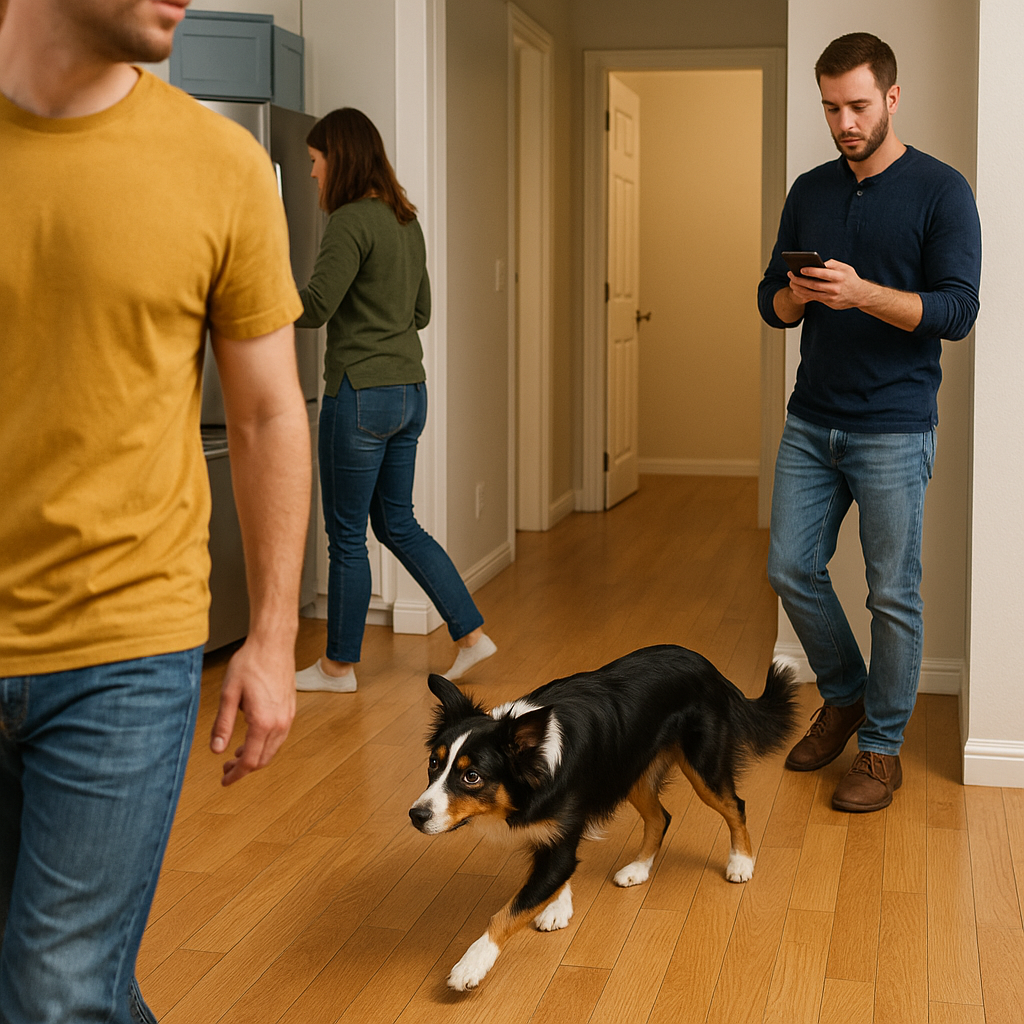
One person moving around the house is background noise. Two people moving is interesting. Three is when my dog starts looking like he has a clipboard. The classic scene in my place is everyone getting up at once: someone heads to the fridge, someone else goes to grab shoes, and I move toward the hallway to find my phone. My dog pops up from a dead sleep and begins doing little arcs between us. Not frantic. More like he's drawing invisible lines so nobody drifts too far apart.
This is the part that convinces people the dog is controlling them, because it feels intentional. In a way, it is. Herding breeds are wired to notice spacing and to reduce it. When the group spreads, they work to compress it. In a house, the targets are human bodies instead of livestock, but the underlying pattern stays the same. You'll see the dog choose the person who's furthest away, cut them off, and then turn back toward the center of activity. Mine will even plant himself in the doorway between the kitchen and living room so the flow funnels past him. If someone tries to pass behind his back, he swivels and resets his position, like he can't tolerate a stray.
What's funny is how often this shows up during completely boring routines. Carrying groceries from the car is a big one. You go out, you come in, you go out again, and suddenly the dog is stationed at the threshold, trying to keep the loop tight. Another is bedtime. If one person heads down the hall and another lingers in the living room, my dog will bounce between the two like he's trying to stitch the household back together before lights-out.
If you want a clean window into the instinct, don't test it with hype or chaos. Just watch the ordinary moments when the family flocks and splits naturally. The dog isn't thinking in words. He's tracking distance, direction, and speed, and he prefers it when the moving parts make one coherent shape. Once you see that, a lot of the weirdness reads less like stubbornness and more like a dog doing the only job he was bred to be good at, right there on your hardwood floors.