This Man’s Final Request Was to Be Displayed in a Museum Next to His Dogs
Before he died, a longtime academic made a request that stood out for its clarity and the personal logic behind it. He had spent decades in lecture halls and research labs, and he wanted his body to serve a purpose after he was gone. What mattered just as much to him, though, were the dogs that had shaped his daily routine for years. So he asked for one specific condition: if his remains were used for scientific display, he wanted to be placed where his dogs were already represented. The idea wasn’t dramatic or symbolic to him. It was simply the most honest way he could imagine closing his life.
A Life Built Around Bones and Loyalty
Image via iStockphoto/Skynesher
Grover Krantz was born in 1931 and grew up obsessed with animal skeletons long before he entered the academic world. He studied at the University of California, Berkeley, later earning his PhD at the University of Minnesota, and then spent decades teaching anthropology, human evolution, and forensics at Washington State University.
Colleagues and students knew him as sharp, stubborn, unpredictable, and oddly lovable. He published academic work on human evolution and also became known for taking Bigfoot seriously as a subject of study, which brought criticism and interest.
Outside of the classroom, his world revolved around Irish wolfhounds. His most famous dog, Clyde, was enormous, about 160 pounds, standing more than 7 feet tall when upright. Clyde wasn’t just a pet. He wrote a book about him, tracked his growth like a scientist, and credited him with pulling him out of a destructive spiral earlier in life. After Clyde died in 1973, he buried him, then later dug up the remains to preserve the skeleton among his research collection. Two more wolfhounds, Icky and Yahoo, later joined that legacy. In time, the yard reflected everything he was: a scientist who followed his questions closely and a man who loved these dogs enough to record every part of their lives.
An Unusual Final Arrangement
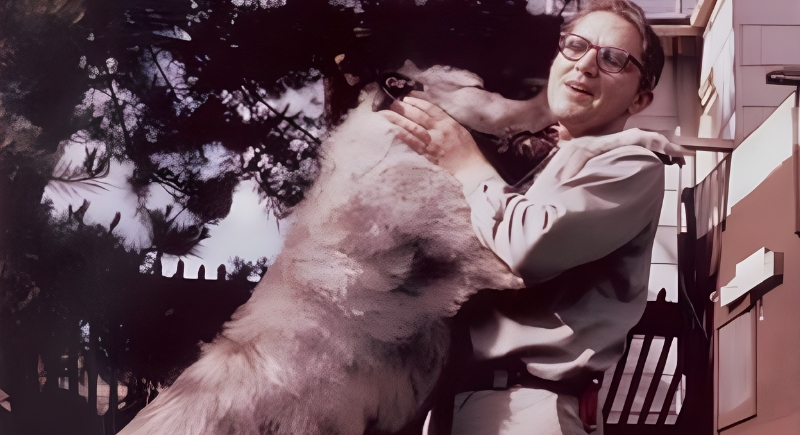
Image via Wikimedia Commons/Unknown
In the late 1990s, pancreatic cancer forced his world to slow down. Retirement brought him to Washington’s Olympic Peninsula with his wife, Diane Horton, but his thoughts drifted to an unusual question: what happens to a lifetime of knowledge after death? Instead of a traditional funeral, he contacted Smithsonian anthropologist David Hunt with a clear request. He wanted his body donated to science. And he wanted his dogs to remain with him.
He died on Valentine’s Day in 2002, and his body was sent to the University of Tennessee’s body farm. There, scientists studied natural human decomposition to help improve forensic investigations used by detectives and coroners. A year later, his skeleton was transferred to the Smithsonian’s National Museum of Natural History.
Inside a pale green cabinet, his bones rest on carefully arranged trays. Directly above him sit the bones of Clyde, Icky, and Yahoo. His skull is placed with care. Nearby are odd personal remnants, including his childhood baby teeth saved in an old film canister.
Still Teaching After It All
Krantz’s place in the museum isn’t for show. Hunt brings out his skeleton for upper-level students who need to learn how to read the details of a human body. They study the wear in his joints, the signs of age, and the clues that connect bones to medical histories. Criminal justice students use those same lessons to understand what real investigations demand. Even without a voice, he’s part of the room, guiding people through the questions he spent his life exploring.
Krantz often described himself simply as a teacher. In a way, he kept that role going. His work continues in the hands of students who gather around his bones, and he remains in the museum beside the dogs that meant the most to him.