This Rare Parrot Can’t Fly and Has a Tragic Love Life Involving Rocks
For years, conservation teams in New Zealand followed individual parrots that lived long enough to outlast the people studying them. Some males returned to the same display sites each breeding season and called for females that never arrived. In certain years, researchers found only males, which created serious concern about whether the species could sustain itself. Every chick that survived did so because people tracked nests closely and stepped in when needed.
The bird at the center of this effort is the kākāpō, a flightless parrot found only in New Zealand. Its biology is unusual, and when mates are scarce, natural breeding behavior can go off track in ways that feel deeply sad to witness. That reality explains how close the species came to disappearing.
The Flightless Parrot That Broke Evolution Rules
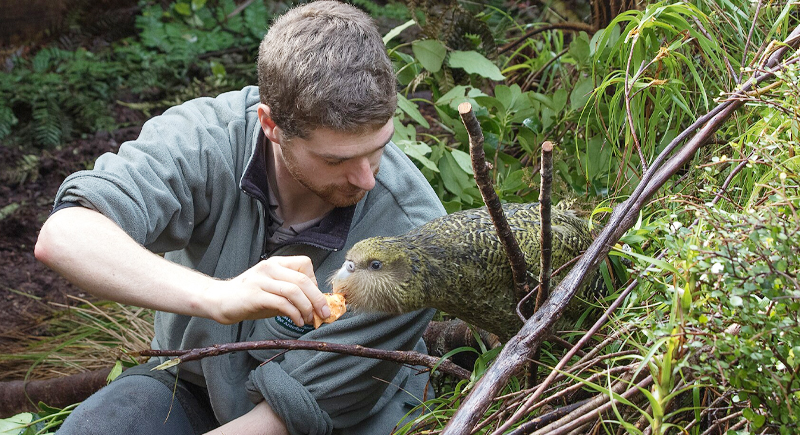
Image via Wikimedia Commons/Kimberley Collins
Kākāpō are the heaviest parrots alive, reaching about 4 kilograms or roughly 8.8 pounds. They are also the only parrot species that cannot fly. Strong legs help them travel several kilometers during nightly foraging trips. They climb trees using claws and beaks, then leap down using wings for balance.
The name “night parrot” in Māori fits perfectly, as they are active after sunset. Their green and brown feathers help them blend into the forest’s ground cover. When danger appears, they freeze instead of running. That strategy worked against aerial predators that hunted using sight. But it failed badly once ground predators such as rats, stoats, cats, and dogs entered New Zealand ecosystems.
Kākāpō can live between 60 and 90 years, so each bird represents decades of care. That long lifespan means population recovery takes patience, since new generations arrive slowly even under close conservation management.
A Dating System That Barely Works
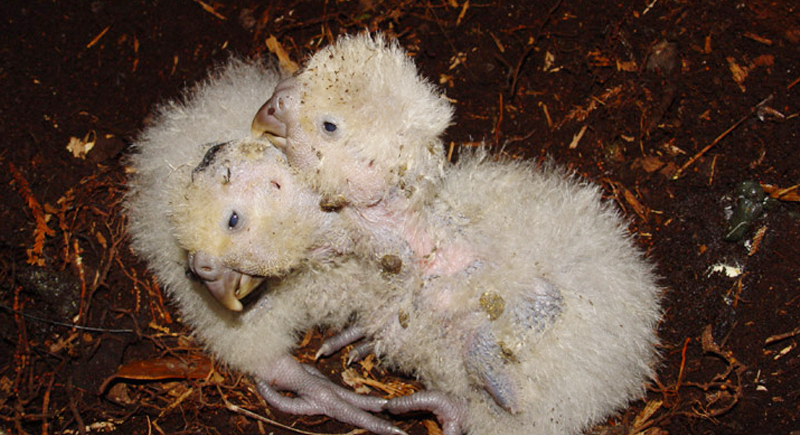
Image via Wikimedia Commons/Department of Conservation
Kākāpō breeding behavior is extremely rare among parrots. Males create display courts by digging shallow bowls into the soil. They then produce deep booming calls that can travel up to 5 kilometers. Males can boom up to 1,000 times per hour, sometimes continuing for 8 hours per night over 2 to 3 months. This system, called lek breeding, means females choose mates after visiting these display sites. But the problem is that if there are few females, many males never mate at all.
During the 1970s, surveys in Fiordland found mostly male birds. By 1995, only 51 total kākāpō were confirmed alive, and at that stage, conservation teams feared breeding might collapse completely. Breeding also depends heavily on the fruit cycles of the rimu tree. If trees produce poor fruit seasons, birds often skip reproduction entirely. Even when eggs are laid, only about 60 percent are fertile. Roughly one-third of fertile eggs reach the chick stage.
When Instinct Has Nowhere To Go
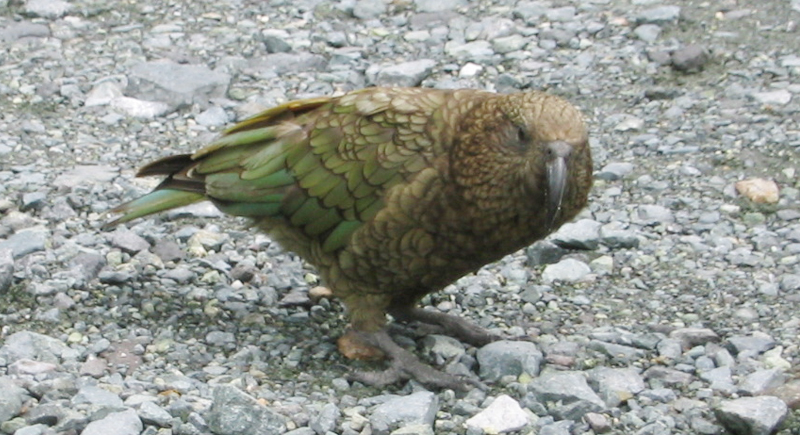
Image via Wikimedia Commons/The_Rambling_Man
Scarcity has created unusual behaviors. In cases documented by researchers, isolated males have attempted to engage in mating behavior with objects such as rocks or equipment. A famous case involved a hand-raised male named Sirocco. He became widely known after attempting to mate with a wildlife cameraman’s head during filming!
This might sound funny at first, but in reality, it shows how severe population imbalance can affect survival. When birds cannot find mates, reproduction stops. For a species that breeds only every two to four years, that creates a huge risk.
Humans Became The Only Reason They Survived
Modern recovery programs are extremely hands-on. Remaining birds live on predator-free islands such as Whenua Hou and Anchor Island. Every individual carries a transmitter, so scientists track movement, diet, and health across entire lifetimes.
During breeding seasons, teams monitor nests around the clock. Eggs are often removed for artificial incubation. Chicks may be hand-raised if mothers struggle, and smart eggs that copy chick sounds help mothers accept returned hatchlings.
Genome sequencing projects have mapped DNA across the entire population to manage inbreeding risk. Recent counts indicate a population of around 200 birds, a huge increase compared with the 1990s, though still fragile.
Long-term plans aim to remove invasive predators across parts of mainland New Zealand by 2050. If that succeeds, kākāpō could regain natural habitats after more than a century of decline.