This Shark Has Been Alive Since the 1600s, and It Is Still Swimming Today
A Greenland shark swimming through the North Atlantic today may have been alive before the modern world existed. Researchers have confirmed that some of these sharks were born in the 1600s, making them the oldest known vertebrates on Earth. This conclusion is based on direct scientific dating of living animals. While human civilizations transformed through wars, industry, and technology, this shark continued its slow life in deep, freezing water, largely unchanged.
A Lifespan Measured in Centuries, Not Decades
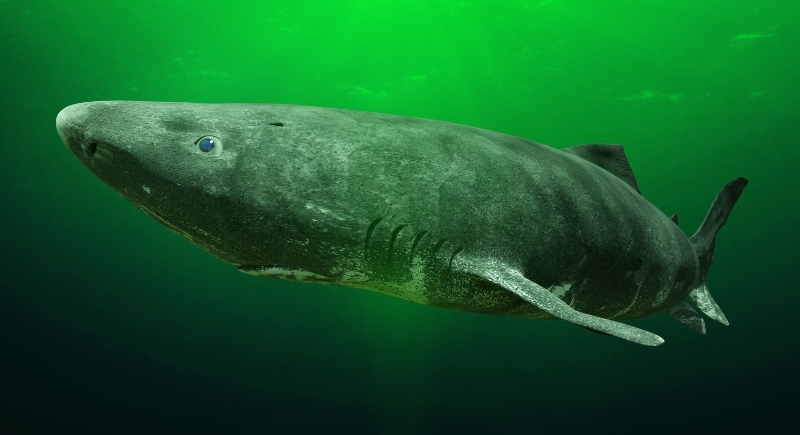
Image via Getty Images/dottedhippo
The idea that a shark could live for 400 years once sounded implausible, even to marine biologists. That changed in 2016, when researchers published evidence showing that Greenland sharks are the longest-living vertebrates ever documented. The oldest individual studied was a female measuring about 5 meters (16 feet). Based on physical dating, her most probable birth year fell in the 1600s.
This finding came from analyzing tissue that formed before the shark was born and never changed afterward. The result forced scientists to rethink biological aging in large animals.
How a Shark’s Eyes Revealed Its Age

Image via Wikimedia Commons/Hemming1952
Greenland sharks lack the hard bones or growth rings that scientists typically use to estimate age. For decades, that made them nearly impossible to date. The breakthrough came from an unexpected place: the eye lens.
The core of a Greenland shark’s eye lens forms before birth and remains chemically stable for life. By radiocarbon dating those proteins, researchers could determine when the tissue first formed. Traces of carbon-14 from nuclear testing in the 1950s and 1960s helped anchor the timeline.
When scientists applied this method to 28 sharks, the results showed that even the youngest adults were far older than previously assumed. The oldest had an estimated age of about 400 years, with a possible range that still exceeded any known vertebrate lifespan.
A Life That Moves at a Different Speed
Everything about the Greenland shark unfolds slowly. It grows at roughly 1 centimeter per year. At that pace, reaching full size can take centuries. Sexual maturity does not occur until around 150 years of age, meaning many sharks spend more time growing than most species spend alive.
The shark’s environment reinforces this slow rhythm. It lives in water that hovers around −1.6°C, or 29°F, often at depths exceeding 1,200 meters, or 4,000 feet. Cold temperatures reduce metabolic demand, and the shark’s low-energy lifestyle minimizes wear on its body over time.
Its swimming speed averages about 0.3 meters per second. This is not an animal built for pursuit. It is built for endurance.
What It Eats While the World Changes Above
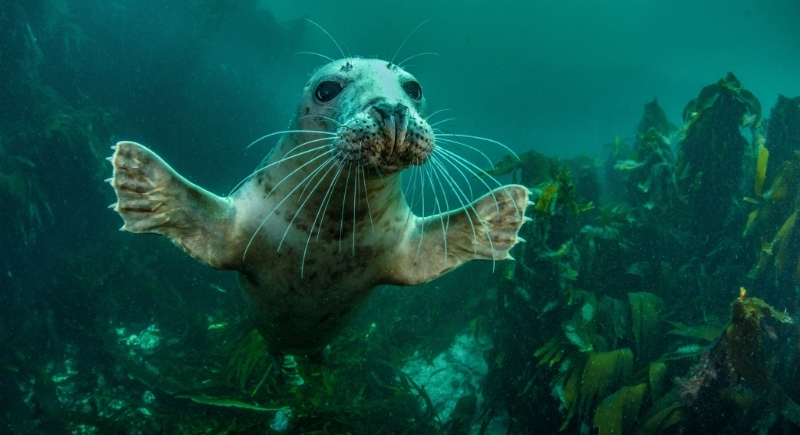
Image via Canva/Adam Hanlon
Greenland sharks are not picky eaters. They consume fish, seals, and other marine animals, but they are also scavengers. Scientists have found remains of reindeer and polar bears in their stomachs, likely eaten after carcasses fell through Arctic ice.
This feeding strategy allows the shark to survive without frequent hunting. Energy conservation is central to its survival, and that same conservation may be tied to its extraordinary lifespan.
Many Greenland sharks carry copepod parasites attached to their eyes. These parasites can impair vision, but sight is not essential in the deep ocean. The shark relies more on smell and vibration, senses that function well in darkness.
A Survivor of Human Exploitation
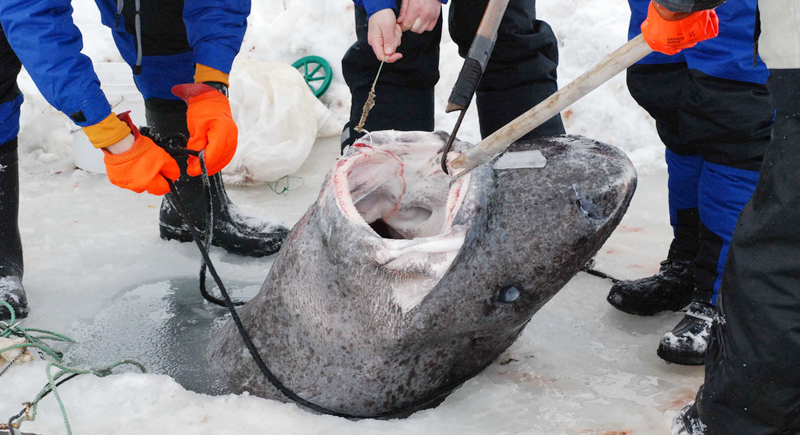
Image via Wikimedia Commons/Julian Idrobo
For much of the 19th and early 20th centuries, Greenland sharks were heavily hunted for their liver oil, which was used as machine lubricant before synthetic oils became common. That fishing pressure likely removed many of the oldest individuals from the population.
Because Greenland sharks reproduce so late in life, population recovery happens slowly. Some scientists believe modern populations are still rebuilding from exploitation that ended more than 80 years ago.
Today, most Greenland sharks are caught only as accidental bycatch. Their deep-water habitat keeps them largely out of human reach, which may be one reason the species still exists at all.
What This Shark Changes About Biology
The Greenland shark forces a rethinking of biological limits. No other known vertebrate combines massive body size with a lifespan measured in centuries. Its existence raises new questions about aging, cellular repair, and metabolic control.
Researchers are now studying the shark’s genetics, immune system, and heart function to understand how such longevity is possible. While this research is ongoing, the animal already stands as proof that extreme lifespan is not limited to small or simple organisms.
The shark continues to move through the Arctic depths on a timeline that does not intersect with human urgency.