Tobogganing: Why Penguins Slide on Their Bellies to Move Across Ice
On Antarctic ice, movement itself becomes a survival test, especially for an animal that spends months walking far inland to raise a chick. Emperor penguins travel across frozen sea ice that can stretch for tens of miles, often far from open water. The terrain shifts between smooth slabs, wind-packed snow, and uneven ridges. Their short legs and stocky build make long treks tiring, and every step costs energy they cannot waste. On flat ice, adults move at about 1.5 miles per hour, which feels manageable until the journey stretches on for dozens of miles.
Breeding colonies can sit as far as 75 miles or 120 kilometers inland on fast ice, the thick sea ice anchored to Antarctica’s ice shelves. Tobogganing changes the math. When a penguin drops onto its belly, its weight spreads across a wider surface, and friction drops. Progress speeds up without extra strain, and over long routes, that shift matters more than raw speed. Energy saved on travel stays available for warmth, foraging, and chick care.
Built For Sliding Without Trying
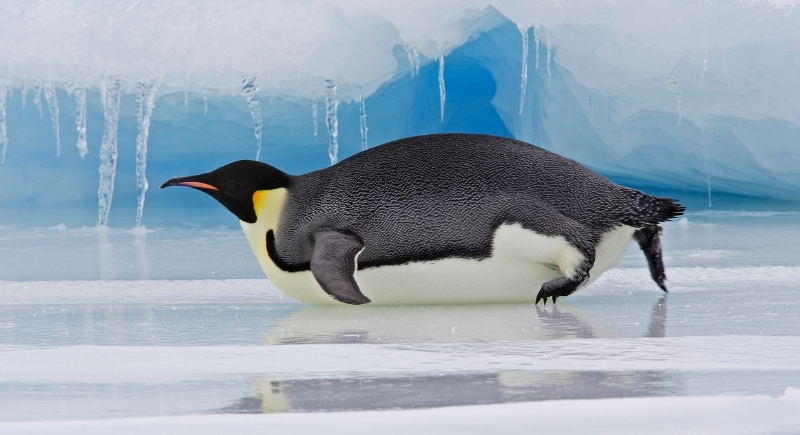
Image via Getty Images/Michel VIARD
Emperor penguins do not need to learn how to slide. Their bodies are already built for it. Dense feathers sit tightly together and are kept in condition through constant preening. Natural oils from a gland near the tail spread across the surface, repelling water and creating a slick outer layer that reduces drag against ice and snow.
Body shape does the rest of the work. A rounded belly forms a stable surface for gliding, flippers act like paddles for extra push, and feet help with steering, slowing down, or stopping. On hard ice, the motion looks smooth and controlled. When the snow softens, penguins rely more on their flippers to keep moving forward.
Ice Dictates The Route
Fast ice offers stability but not consistency. Cracks open, pressure ridges rise, and penguins adjust without overthinking it. Small breaks are crossed in a slide, while wider gaps require a brief return to walking until a safer crossing becomes available.
However, ridges present a tougher test. Penguins climb them belly-down, anchoring with their beaks to stop backward slides. Once over the crest, gravity does the rest. The move looks clumsy, yet it saves time and reduces falls.
Group Behavior Shapes The Choice
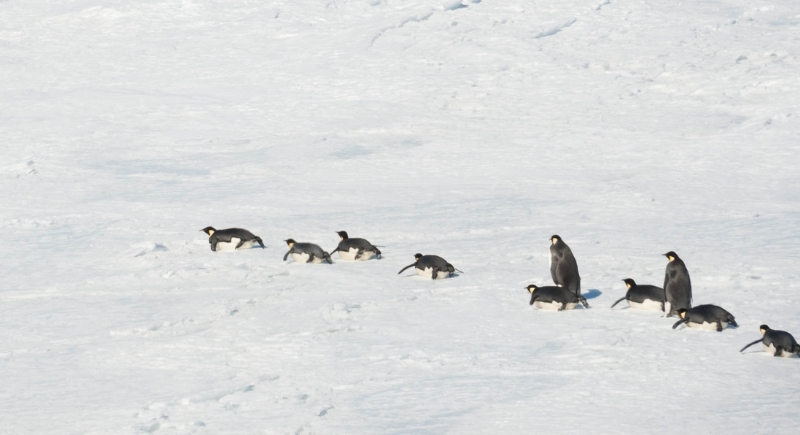
Image via Getty Images/VargaJones
Emperor penguins almost never move on their own. Travel choices tend to spread through the group, with one bird’s decision quickly influencing the rest. When a few start walking, others often follow, even if sliding would use less energy. This behavior reflects the importance of staying together rather than a poor choice in movement.
Over long distances, though, sliding usually wins out. Tracking studies show that tobogganing requires less effort during extended journeys, especially across flat ice. Penguins that conserve more energy on these trips arrive in better condition, which matters once the demands of breeding season begin.
A Strategy Tied To Survival
Tobogganing links directly to the penguin life cycle. Adults leave the ocean after feeding and head inland to breed on stable ice, where they are safe from waves and marine predators. Once chicks hatch, parents shuttle food back and forth across the same frozen ground, but each trip demands efficiency.
Sliding conserves energy during travel, so more remains available for thermoregulation in brutal cold. For a bird standing around four feet or 1.2 meters tall, built for swimming rather than walking, the belly slide becomes the logical answer.
Overall, penguins appear to have chosen a fun shortcut, but in reality, their behavior reflects the interplay of physics, anatomy, and survival pressures. Tobogganing solves a problem that legs alone cannot.