Why Penguins Often Perceive Humans as Their Own Kind
Penguins do not react to people the way most wild animals do. When a human appears on an Antarctic shoreline, many penguins do not scatter or hide. They keep walking. Some pause a short distance away and stare, while others move closer, as if inspecting an unfamiliar figure. That calm curiosity has led to the idea that penguins see humans as fellow penguins. The reality is more subtle, shaped by biology, perception, and a long history of living with almost no land predators.
A World Without Land Predators
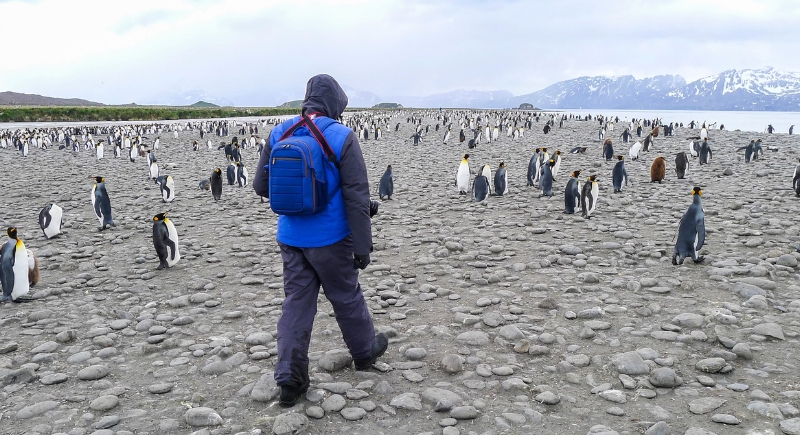
Image via iStockphoto/burroblando
For millions of years, most penguin species evolved in places where land predators barely existed. In Antarctica, adult penguins face danger almost exclusively in the water. Leopard seals and orcas hunt them at sea, while skuas may target eggs or chicks from above. On land, however, adult penguins have had little reason to fear large animals walking toward them.
Because humans arrived extremely late in penguin evolutionary history, penguins never developed an instinctive fear response to upright, slow-moving figures. Evolution shapes fear through repeated threats over many generations. Without that pressure, penguins simply lack the built-in alarm system that many other animals use when they encounter people.
Why Walking Upright Matters
Penguins rely on specific visual cues to identify danger. Their predators approach from low, fast, or aerial or aquatic sources. A tall figure moving slowly on two legs does not match any of those patterns.
In Antarctica, penguins themselves are the only animals that regularly walk upright on land. When they see a human doing the same thing, the silhouette does not register as a threat. To a penguin’s brain, a standing human is closer to a strange, oversized penguin than to a predator.
This does not mean penguins think humans are penguins in a literal sense. It means humans fail to trigger the penguin’s danger filters.
When fear is absent, curiosity takes over. Penguins constantly monitor their surroundings. An unfamiliar shape that does not behave aggressively becomes something to inspect rather than avoid.
Researchers and expedition guides have long observed that penguins are more likely to approach people who remain still and quiet. Sudden movement usually sends them retreating. Calm, predictable behavior allows them to get close enough to assess what they are seeing, often resulting in the famous waddling inspections.
In areas with long-term research stations or managed tourism, penguins become accustomed to human presence. Repeated encounters that end without harm reinforce the idea that humans pose little risk.
This learning happens quickly. Young penguins observe adult behavior and copy it. If adults remain calm around people, juveniles do the same. Over time, entire colonies may appear unusually tolerant, even though the response is learned rather than innate.
A Quirk of Evolution, Not Affection

Image via Getty Images/Andrew Peacock
Despite how charming these encounters look, penguins are not seeking connection with humans. They are responding to a lack of threat and a strong instinct to observe novelty.
Penguins that appear calm can still become stressed by close contact, loud noises, or interference during breeding and molting seasons. Wildlife guidelines exist for a reason. What seems to be acceptance can shift quickly if humans behave unpredictably.
Penguins do not mistake humans for companions, even though the interactions can feel personal—even flattering.